Project Showcase TAS News TAS Blogs Contact Us

  • /

  • /

  • TAS CT Sector Newsletter

TAS CT Sector Monthly Newsletter

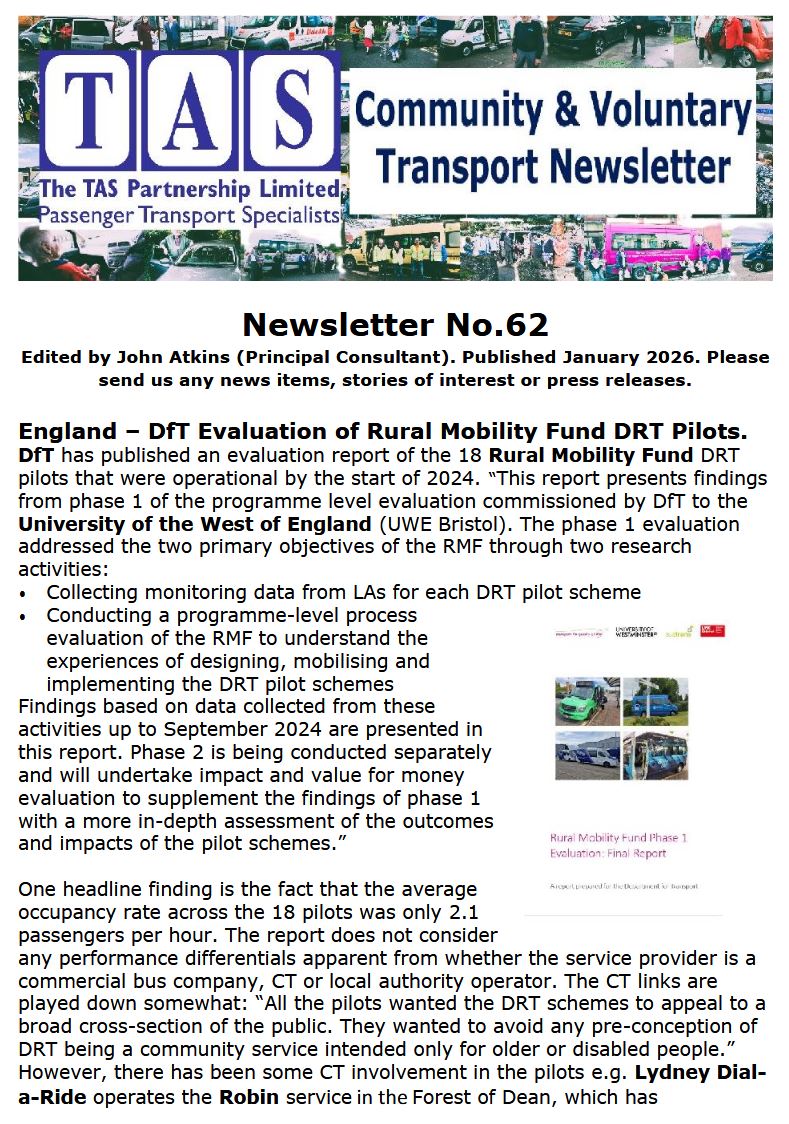
Community Transport Newsletter No.62

To follow our well-received COVID-19 newsletter we have decided to produce a new general newsletter for the CT sector which we hope to produce each month. This aims to provide a roundup of CT stories and relevant items from around the UK and beyond. Please let us know if you have any interesting items or stories that you wish to share.

The latest edition can be viewed here: Community Transport Newsletter No.62Previous editions can be viewed here:

CT Newsletter No.61
CT Newsletter No.60
CT Newsletter No.59
CT Newsletter No.58
CT Newsletter No.57
CT Newsletter No.56
CT Newsletter No.55
CT Newsletter No.54
CT Newsletter No.53
CT Newsletter No.52
CT Newsletter No.51
CT Newsletter No.50
CT Newsletter No.49
CT Newsletter No.48
CT Newsletter No.47
CT Newsletter No.46
CT Newsletter No.45
CT Newsletter No.44
CT Newsletter No.43
CT Newsletter No.42
CT Newsletter No.41
CT Newsletter No.40
CT Newsletter No.39
CT Newsletter No.38
CT Newsletter No.37
CT Newsletter No.36
CT Newsletter No.35
CT Newsletter No.34
CT Newsletter No.33
CT Newsletter No.32
CT Newsletter No.31
CT Newsletter No.30
CT Newsletter No.29
CT Newsletter No.28
CT Newsletter No.27
CT Newsletter No.26
CT Newsletter No.25
CT Newsletter No.24
CT Newsletter No.23
CT Newsletter No.22
CT Newsletter No.21
CT Newsletter No.20
CT Newsletter No.19
CT Newsletter No.18
CT Newsletter No.17
CT Newsletter No.16
CT Newsletter No.15
CT Newsletter No.14
CT Newsletter No.13
CT Newsletter No.12
CT Newsletter No.11
CT Newsletter No.10
CT Newsletter No.9
CT Newsletter No.8
CT Newsletter No.7
CT Newsletter No.6
CT Newsletter No.5
CT Newsletter No.4
CT Newsletter No.3
CT Newsletter No.2
CT Newsletter No.1

Pages

Home
About Us

What we do
Project Showcase

TAS News
Contact Us


Modern Slavery Statement© Copyright The TAS Partnership Limited 2016 The TAS Partnership Limited, Guildhall House, 59-61 Guildhall Street, Preston, Lancashire PR1 3NU | Tel: 01772 204988 A limited company registered in England and Wales Number 2929880, at the above address. Cookies on our websites: We use cookies to ensure we give you the best experience on our website. If you continue, we’ll assume that you are happy to receive all cookies on our website.

Project Showcase TAS News TAS Blogs Contact Us

The TAS Partnership Welcomes National Bus Strategy Despite Concerns

The TAS Partnership Ltd (TAS) welcomes the publication of the long awaiting National Bus Strategy and stands ready to help operators and local authorities achieve the ambitious aims laid out in the strategy. We especially welcome the commitment to long term funding, the largest sum of new bus funding in a generation, both to support the recovery of the public transport sector and thereafter, to facilitate the various improvements required to create patronage growth, including the provision of bus priority. Bus priority is essential to allow services to be enhanced in a viable and attractive manner, for years we have seen congestion stretch journey times and consume vital resources, leading to a reduction in service provision and thus a decline in patronage.
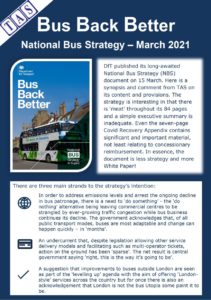
Bus Back Better – National Bus Strategy

TAS is very conscious of the reducing skills pool at local authorities, as a result of cuts in staff numbers and reduced funding and, therefore, are encouraged by the commitment to give Local Transport Authorities (LTAs) the staffing resources needed and the development of a Bus Centre of Excellence. TAS and its associates offer a range of established training courses to the public transport industry, covering history, operation, finance, procurement, planning and service development, at a variety of levels.

TAS has been a long term supporter and promoter of Partnership working between bus operators and LTAs. Whilst it is disappointing that there is a focus on only one type of partnership in the form of the more bureaucratic Enhanced Partnership, it is welcome that this is placed above franchising as a solution to improving bus services. However, the deadline of October 2021 to publish a Bus Service Improvement Plan may prove to be an overly ambitious goal for some areas where stakeholder relationships are less developed.

Many of the ‘vision’ statements made in the strategy reflect our understanding and advice over the last few years, and are heartening to read. In particular, the emphasis on simplified networks, local branding, and the acknowledgement that a lack of evening services reduces the attractiveness of the daytime provision. The focus on ensuring that information is up to date including network maps and at stop timetables is also to be applauded.

Concerns

Some of the content however may reflect a somewhat over-optimistic assessment of what is possible given external barriers, particularly where the availability of finance continues to obligate the maintenance of a mainly commercial proposition. Operation within an Enhanced Partnership will require LTAs to provide more financial support than hitherto and prudence will ensure that they too will need to adopt a quasi-commercial approach to network development to safeguard their investment. Whilst we always encourage fares and networks to be as simple as possible for passengers to understand and use, we also know that a one size fits all approach cannot be applied.

Steps towards flat fare areas should be taken with caution, as often a distance-based fare is the most appropriate approach. The transition to a flat fare risks losing revenue as short distance passengers are priced off the network and longer distance passengers no longer cover their costs.
Similarly having a single high frequency service along a corridor rather than multiple lower frequency services has helped grow ridership in the past. However, there has to be somewhere for the high frequency service to go without creating over-bussing at the outer reaches. Many urban operators already successfully provide high frequency corridors from the combination of less frequent services – this creates the best of both worlds as outlying areas get a reasonable service without over provision. Whether there is a through fare or not, people do not like being forced to change from a feeder to a main service on a simple urban journey and this does not encourage patronage growth.

The focus on app-based DRT as the solution to the rural transport issue is concerning. Whilst these services do play their part there is a whole suite of options that should be available. There is little acknowledgement of the rural premium, the additional price that is paid for living in a rural area. Nor is there mention of existing solutions such as the successful Lincolnshire InterConnect and CallConnect networks where scheduled and demand responsive feeders meet core inter-urban services.

Community Transport (CT) organisations have been providing essential services to rural and urban areas which aren’t viable from a commercial prospect, however there is little mention of CT operations within the strategy. Neither is there a strategy for school services which not only act as a shop window to children and young people, but also allow provision of marginal public services through shared resources. If one of the main objectives is modal shift, tackling the school run should be a priority.

How Can TAS Help?

TAS researched and developed detailed guidance on Enhanced Partnerships for the DfT prior to the Bus Services Act. We are thus in a very strong position to support local authorities and operators to develop and deliver the necessary Partnership agreements. This can be as general support, as third-party intermediary or as critical friend.
To find out more please contact Sarah Huntley (MD) on 01772 204988 or email info@taspartnership.com

Notes to editors:

  1. The TAS Partnership Limited was founded in 1989 and is the UK’s leading specialist public transport consultancy, with a turnover in excess of £500k and more than 20 full-time staff and associates. Clients have included national, regional and local government and public transport operators throughout the country, including all the major groups.
  2. TAS expertise covers bus network analysis and design, concessionary fares, rail services, light rail and bus rapid transit, rural services and networks, plus market research and analysis. In addition, TAS is an acknowledged expert in the fields of community and accessible transport, social service, health and educational transport services, procurement and State Aid issues.
  3. TAS runs industry-wide models covering costs, revenue and patronage for UK bus and rail operations.

Pages
Home
About Us
What we do
Project Showcase
TAS News
Contact Us


Modern Slavery Statement© Copyright The TAS Partnership Limited 2016 The TAS Partnership Limited, Guildhall House, 59-61 Guildhall Street, Preston, Lancashire PR1 3NU | Tel: 01772 204988 A limited company registered in England and Wales Number 2929880, at the above address. Cookies on our websites: We use cookies to ensure we give you the best experience on our website. If you continue, we’ll assume that you are happy to receive all cookies on our website.


Project Showcase TAS News TAS Blogs Contact Us

DfT publishes guidance on the use of S19 & S22

TAS was pleased to see that on the last day of 2020, the Department for Transport published its long-awaited guidance on the use of s19  and s22 Permits following the Judicial Review judgment in November 2019. TAS supported Mobility Matters since the ‘infamous’ Stephen Fidler letter of 31 July 2017 [Yes, it has been that long!] and supported the joint Mobility Matters / CTA representation during the legal proceedings.

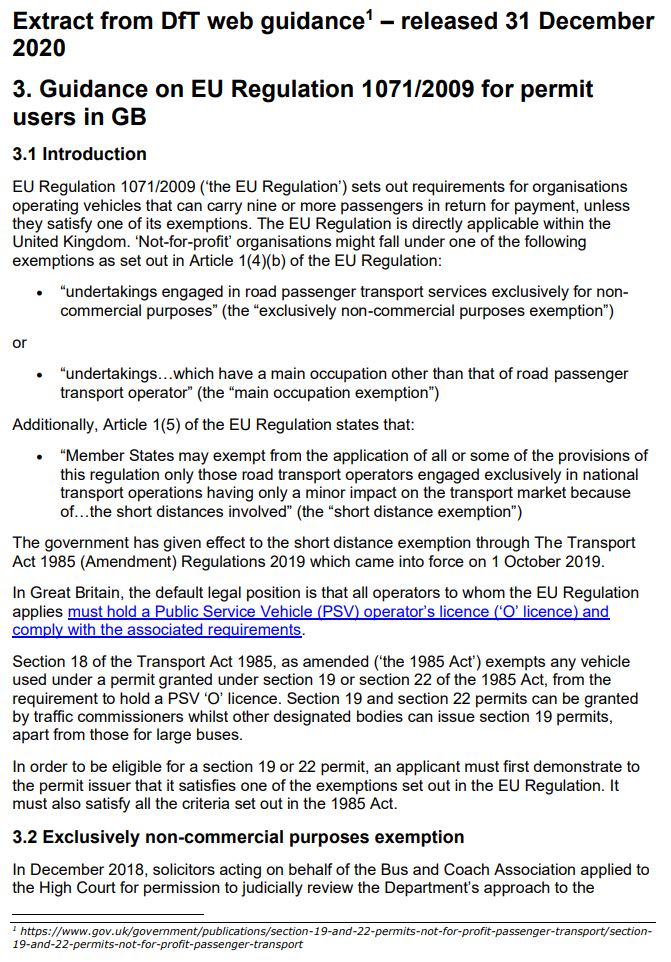
Extract from DfT web guidance – released 31 December 2020

 
The DfT guidance is in the form of an update (section 3) to their standard web guidance on permits. https://www.gov.uk/government/publications/section-19-and-22-permits-not-for-profit-passenger-transport/section-19-and-22-permits-not-for-profit-passenger-transport#guidance-on-eu-regulation-10712009-for-permit-users-in-gb


The relevant section is attached for download.
https://taspartnership.co.uk/wp-content/uploads/2018/02/DfT-Guidance-following-the-JR-released-31-12-20.pdf


TAS will be providing a detailed commentary early in the New Year, but in general terms this guidance:

  1. Is helpful to the CT sector as the DfT accepts many of the detailed arguments that Mobility Matters and CTA have been making
  2. Will disappoint anyone who was hoping for guidance that prevents CTs from undertaking competitive contract work for public authorities
  3. Does put an onus on CTs to be clear and transparent with their objectives when undertaking particular services
  4. Will be assisted if local authorities modify their commissioning processes so that they explicitly take into account their social value duties and their integration duties under s88 Transport Act 1985.

Happy New Year from all of us at TAS

Pages
Home
About Us
What we do
Project Showcase
TAS News
Contact Us


Modern Slavery Statement© Copyright The TAS Partnership Limited 2016 The TAS Partnership Limited, Guildhall House, 59-61 Guildhall Street, Preston, Lancashire PR1 3NU | Tel: 01772 204988 A limited company registered in England and Wales Number 2929880, at the above address. Cookies on our websites: We use cookies to ensure we give you the best experience on our website. If you continue, we’ll assume that you are happy to receive all cookies on our website.

Project Showcase TAS News TAS Blogs Contact Us

/by


Project Showcase TAS News TAS Blogs Contact Us

TAS Welcomes National Audit Office Report in Local Bus Services in England outside London


The TAS Partnership Ltd (TAS) has welcomed the publication of the National Audit Office (NAO) report Improving local bus services in England outside London. This appears to be a well-balanced report highlighting both shortcomings and successes, pointing out that a reduction in funding from both local and national government has contributed to an overall decline in patronage which the report states has been going on for 70 years.

It is particularly encouraging that the NAO has used TAS data, regarding the vicious cycle of decline for bus services to highlight the need to tackle congestion, in order to create successful urban public transport services. The report also rightly focuses on the fact that the current planning system does not support attractive public transport provision for new housing developments.

The key conclusion is that those authorities which have a clear long term strategy for supporting bus services and who work in partnership with operators, have seen the most success. This is backed up by a call for long term, sustained central government funding for service and infrastructure improvements.

The call for the DfT to work more closely with other government departments, local authorities, professional bodies and operators, both in relation to sharing expertise and wider funding solutions, is a strong one. However it ignores the varied and sometimes complex distribution of power and responsibility across different authorities, where even one Combined Authority differs to another in its responsibility for transport. Without tackling this issue the NAO’s desire for transparency and accountability cannot be met.

It is disappointing that the support for partnerships is only included in the body of the report and not stated in the Key Points at the start. This is prominent in the statement that deregulation means that operators are not accountable to either national or local government, but fails to acknowledge that a successful partnership will make operators and local authorities more accountable to each other.


Notes to editors

  1. The TAS Partnership Limited was founded in 1989 and is now the UK’s leading specialist public transport consultancy, with a turnover in excess of £500k and over 25 full-time staff and associates. Clients include national, regional and local government and public transport operators throughout the country, including all the major groups.
  2.  

  3. TAS expertise covers bus network analysis and design, concessionary fares, rail services, light rail and bus rapid transit, rural services and networks, plus market research and analysis. The company has worked extensively on franchise bids for rail and have expertise in all forms of scheduling. In addition, TAS is an acknowledged expert in the fields of community and accessible transport, social service, health and educational transport services.
  4.  

  5. TAS maintains extensive databases on the financial and market performance of the bus, rail and light rail industry, and run industry-wide models covering costs, revenue and patronage for UK bus and rail operations.

Pages
Home
About Us
What we do
Project Showcase
TAS News
Contact Us


Modern Slavery Statement© Copyright The TAS Partnership Limited 2016 The TAS Partnership Limited, Guildhall House, 59-61 Guildhall Street, Preston, Lancashire PR1 3NU | Tel: 01772 204988 A limited company registered in England and Wales Number 2929880, at the above address. Cookies on our websites: We use cookies to ensure we give you the best experience on our website. If you continue, we’ll assume that you are happy to receive all cookies on our website.

Project Showcase TAS News TAS Blogs Contact Us

Bus strategy must look beyond the industry

By Matthew Moll

Starting this month our colleague Matthew Moll will a regular contributor to Route One magazine. Read his first comment piece on improving the viability of the Bus Industry below.


The government now wishes to see an independent bus industry – but any strategy to improve its commercial viability must look beyond the industry itself

The Department for Transport (DfT) press release on 8 August regarding extension of the coronavirus COVID-19 support fund for bus and light rail also reiterated the government’s commitment to publishing a National Bus Strategy. This was preceded by a statement that “the government is also actively working on ways to ensure the bus sector can operate independently and be commercially viable.”

It should firstly be acknowledged that some concurrent central and local government transport policies have a negative impact on the commercial viability of the bus industry. These include:

  • Cheap or even free car parking, a long-term freeze in fuel duty and incentives for electric car ownership have all supressed motoring costs
  • Increasing the number of cycle lanes by reducing road space, reduces the ability of traffic, including buses, to use the road efficiently – increasing journey times
  • Pedestrianisation of town centres means bus stops are moved to less convenient locations – adding operating costs through increasing mileage and reducing the attractiveness of a service
  • Reopening railway stations and lines (with heavy government subsidy) will attract passengers away from what are often well used interurban bus routes.

The big question is whether the National Bus Strategy will simply cover internal factors which are within the control of operators, transport authorities and DfT, or include dealing with more external factors. Internal factors include funding for bus priority measures, which reduce operating costs, and making concessionary fare reimbursement across England consistent, simpler and fairer, with the right funding level from central government.

External factors should create new and better markets for bus services. Demand responsive transport (DRT) ventures are useful for serving dispersed communities, but are almost impossible to run commercially due to the intrinsically small passenger loadings and high costs. It is also notable how many DRT services return quite quickly to a timetabled operation.

Traditional bus services are best suited to serving densely populated areas and concentrated economic attractors. It seems obvious that the government needs to protect and stimulate jobs in urban centres while legislating in a manner that discourages new hospitals, business parks and other developments in the middle of nowhere.

New housing developments as a whole need to be better planned around public transport rather than it being an afterthought. All too often potentially commercial services are withdrawn or require local authority support once the Section 106 funding runs out. Services supported by Section 106 are frequently faced with unsuitable and unfriendly infrastructure and routeing options and a developer which is unwilling to assist with promotion, while funding begins after the first tranche of residents has been forced to become car dependent.

It is encouraging that after a couple of years of toying with the idea of franchising, the government now wishes to see an ‘independent and commercially viable bus industry’. However, it needs to ensure that any strategy covers external as well as internal factors.


This article and future ones by Matthew can be read on the Route One website at this link. (https://www.route-one.net/opinion/bus-strategy-must-look-beyond-the-industry/)

Pages
Home
About Us
What we do
Project Showcase
TAS News
Contact Us


Modern Slavery Statement© Copyright The TAS Partnership Limited 2016 The TAS Partnership Limited, Guildhall House, 59-61 Guildhall Street, Preston, Lancashire PR1 3NU | Tel: 01772 204988 A limited company registered in England and Wales Number 2929880, at the above address. Cookies on our websites: We use cookies to ensure we give you the best experience on our website. If you continue, we’ll assume that you are happy to receive all cookies on our website.
Project Showcase TAS News TAS Blogs Contact Us

Bus Franchising: “Lots More Thought Required Before Implementation”

Our Senior Consultant Matthew Moll was recently featured on the RouteOne website offering a response to Abellio’s proposals for bus franchising – and observing that commercial operation, if done properly, can form a blueprint to drive patronage growth across the country.

Link to the article can be found here: https://www.route-one.net/bus-routes/bus-franchising-lots-more-thought-required-before-implementation/

Pages
Home
About Us
What we do
Project Showcase
TAS News
Contact Us


Modern Slavery Statement© Copyright The TAS Partnership Limited 2016 The TAS Partnership Limited, Guildhall House, 59-61 Guildhall Street, Preston, Lancashire PR1 3NU | Tel: 01772 204988 A limited company registered in England and Wales Number 2929880, at the above address. Cookies on our websites: We use cookies to ensure we give you the best experience on our website. If you continue, we’ll assume that you are happy to receive all cookies on our website.

/by

Project Showcase TAS News TAS Blogs Contact Us

Future of Transport Regulatory Review:Call for Evidence

Response from The TAS Partnership Ltd


The Department for Transport recently consulted on a number of topics in the context of its ‘Future of Mobility’ programme. This consultation focused on potential regulatory / legislative changes in respect of:

The consultation background and questions can be seen here: https://www.gov.uk/government/consultations/future-of-transport-regulatory-review-call-for-evidence-on-micromobility-vehicles-flexible-bus-services-and-mobility-as-a-service


TAS Partnership Ltd Response

The detailed TAS response can be found here. This was underpinned by three key considerations:

Our response called on our experience delivering a recent international benchmarking project on ‘Powered Personal Transport’, decades of involvement with planning and implementing demand-responsive transport services and our work developing Best Practice Guidance on Bus Partnerships for the Department for Transport.


For information about this or any other aspects of our work, email or call Sarah Huntley – sarah.huntley@taspartnership.com  01772 204988

Pages
Home
About Us
What we do
Project Showcase
TAS News
Contact Us


Modern Slavery Statement© Copyright The TAS Partnership Limited 2016 The TAS Partnership Limited, Guildhall House, 59-61 Guildhall Street, Preston, Lancashire PR1 3NU | Tel: 01772 204988 A limited company registered in England and Wales Number 2929880, at the above address. Cookies on our websites: We use cookies to ensure we give you the best experience on our website. If you continue, we’ll assume that you are happy to receive all cookies on our website.
/by

Project Showcase TAS News Contact Us

Covid-19 Statement

First of all we hope that all our friends and colleagues across the UK and around the world can stay healthy during this unprecedented emergency. We are thinking of you.

Here at TAS we have the ability for all our staff to work from home whilst securely accessing our data and emails, so we do not anticipate any break of service. Calls to our landline are diverted to mobiles as necessary. We will maintain usual office hours.

We are in regular discussion with our local authority and operator clients about the new challenges that they are facing on a daily basis and have been assisting with ideas for changed policies, services and resource prioritisation as well as by drafting new procedures to help frontline staff. We have a particular interest in helping ensure that access opportunities are maintained for older and more vulnerable passengers or are replaced with alternative delivery and visiting services.

The simple message is that we are here and fully functional and available to help you.

In the coming days we will be putting more information on our website covering Covid-19 issues and look forward to hearing from everyone with the challenges and successes of overcoming the threat that this virus constitutes.

Pages
Home
About Us
What we do
Project Showcase
TAS News
Contact Us


Modern Slavery Statement© Copyright The TAS Partnership Limited 2016 The TAS Partnership Limited, Guildhall House, 59-61 Guildhall Street, Preston, Lancashire PR1 3NU | Tel: 01772 204988 A limited company registered in England and Wales Number 2929880, at the above address. Cookies on our websites: We use cookies to ensure we give you the best experience on our website. If you continue, we’ll assume that you are happy to receive all cookies on our website.

/by

Project Showcase TAS News Contact Us

TAS National Bus Fares Survey Highlights Push away from Cash Payments


Rapid roll-out of Contactless payment and an average of 2.6% discount for purchasing an M-Ticket over a paper ticket indicate a growing trend of bus operators seeking to move passengers away from cash payments in an attempt to speed up journey times and reduce revenue collection costs. The survey also highlights operators are taking a hit with below cost and below inflation price increases on period products.

The TAS National Bus Fares Survey (NFS) 2019 analysed 1,093 sample three mile bus journeys across Great Britain excluding London. Immediate outputs showed the average three mile adult single fare to be £2.48, the average adult day ticket to be £5.21 and the average adult weekly ticket to be £18.03.

The lowest single fare for an adult traveling three miles was provided by Richards Bros in Fishguard at £0.85 which also had the lowest average single fare at £1.25. The municipal operators offered the lowest average single fare for an operating group of £2.04. The highest fare for a three mile trip was £5.00 on First Kernow in Falmouth.

First West of England’s FirstDay ticket in Weston-super-Mare was the lowest priced day ticket at £2.50 whilst Stagecoach South’s Guildford Local Megarider was the cheapest weekly ticket at £7.00. National Express’s roll-out of Low Fare Zones in the West Midlands has seen its average day ticket price reduce by 2.6%.


Contactless – the New Technology

Whilst availability of Mobile Ticketing appears to have reached market saturation, with 94% of samples having an m-ticket available (compared to 92% in 2017), contactless payment availability has already overtaken it at 96% availability, a whopping increase of 66% since 2017. This is largely due to the commitment by the big groups to provide this facility and the investment by many smaller operators in new ticket machines.

Operators however are still backing m-tickets, offering on average a 2.6% discount for a weekly ticket bought via an app against those bought on bus. FirstBus offers the greatest average discount at 7%, whilst Stagecoach Merseyside and South Lancashire offers the largest individual discount at 20% on its ‘Merseyrider Plus’ ticket.


Multi-Journey Savings

The average Weekly ticket represents a saving of 27% against ten times the average single fare and a 31% saving over five day tickets. This means that even when only travelling four days a week there is a saving to be made.

The average Weekly ticket represents only 2.8% of the average weekly wage in Great Britain against the cost of owning and running a car which represents 13.3% of the Great British average weekly wage.

Whilst the average single fare has increased by 0.8% above RPI and 0.4% above industry costs since 2017, weekly tickets have increased at the rate of RPI and crucially 0.4% below industry costs. This means that operators are seeking to reward their regular passengers rather than profit from them, indeed over ten years weekly tickets have increased by an average of 3.2% below RPI. In comparison over the same period, regulated rail fares have increased by 6.6% above RPI.


Views from the Industry

TAS Senior Consultant Matthew Moll said “With data spanning ten years we are really able to get a good view of how the industry has changed over time. A persistent theme has been the low increase in multi-journey product prices but the technology for paying for and storing these tickets has constantly evolved. The range of single fares offered for the same length journey, from £0.85 to £5, show that there is a large number of factors that determine bus fares on a local level.”

CPT Chief Executive Graham Vidler said: “The survey results clearly show that despite the impact congestion is having on operators’ costs bus travel by and large remains good value for money, with the average weekly ticket still costing less outside of London than within it. Significant investment in new technology by operators now also means that almost every ticket surveyed could have been purchased using contactless payment.”

Martin Dean, Managing Director – Bus Development at the Go-Ahead Group said “The TAS National Fares Survey is a great benchmark for our industry. The 2019 report highlights how bus operators are not only seeking to reward regular travellers through attractive discounts, and are keeping weekly ticket price increases at or below inflation, as they have done for over a decade, but are also investing in customer convenience, as the dramatic increase in contactless payment acceptance detailed in the survey demonstrates.”

The full report and previous editions can be found here:

https://taspartnership.co.uk/what-we-do/national-fares-survey/


Pages
Home
About Us
What we do
Project Showcase
TAS News
Contact Us


Modern Slavery Statement© Copyright The TAS Partnership Limited 2016 The TAS Partnership Limited, Guildhall House, 59-61 Guildhall Street, Preston, Lancashire PR1 3NU | Tel: 01772 204988 A limited company registered in England and Wales Number 2929880, at the above address. Cookies on our websites: We use cookies to ensure we give you the best experience on our website. If you continue, we’ll assume that you are happy to receive all cookies on our website.

/by