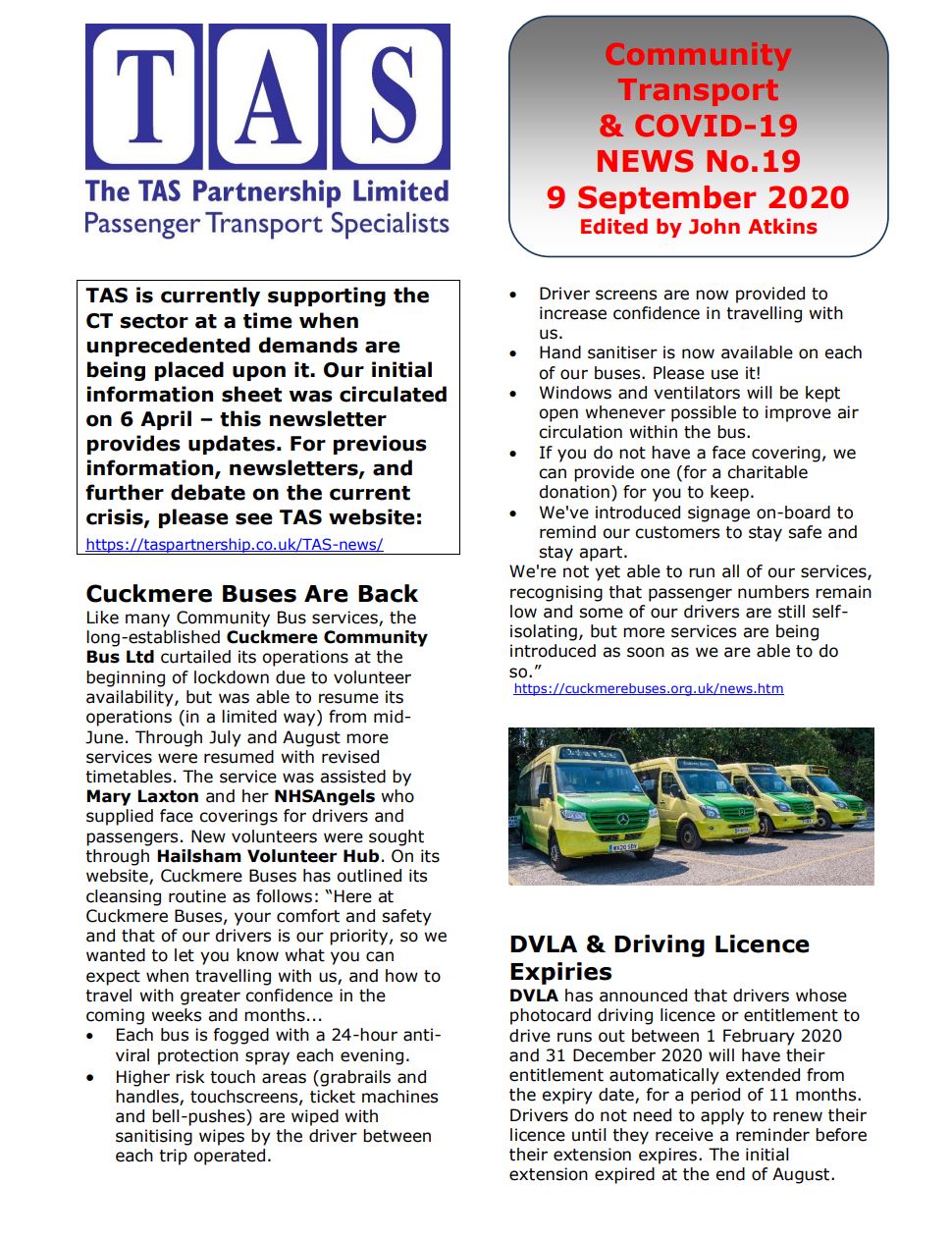
TAS is currently supporting the CT sector at a time when unprecedented demands are being placed upon it. Our latest newsletter, which provides updates, guidance and experiences from around the country for CT operators and local authority transport staff, can be downloaded here: Community Transport & COVID-19 Newsletter No.19
There are times when it seems barely a week goes by without some proposal to change local government structure somewhere. Either a proposal to merge authorities into one larger one, split larger ones into smaller ones or, as with the most recent proposals for Gloucestershire and Lancashire, throw the whole lot up in the air, let it settle into three chunks and figure out what to name them at some point in the future… yet to be defined. The only consistency is that whatever proposal is on the table will, of course, save millions. That’s a mantra we’ve heard since the 1974 creation and then subsequent break-up in 1996 of Avon, Cleveland and the rest into unitary district councils, with no great evidence of massive efficiency improvements.
The Scots and Welsh have had unitary authorities across the patch for some time. The Scottish structure is perhaps the happiest, as most in Wales agree many Welsh authorities are too small, although the almost annual review of local government structure in Wales always seems to be filed under ‘too difficult’ for any reorganisation to happen.
In England it’s nothing short of a complete mess: We have counties, districts, unitary counties, unitary districts and metropolitan districts. These are overlaid by combined authorities which are nothing of the sort, merely a sort of joint committee with limited powers and responsibilities. After some abortive initial attempts to include selected district councils, it seems Central Government only signed off combining an authority which is already a unitary or county. Then there’s York, which sits remotely as part of but not fully a part of the West Yorkshire Combined Authority!
Elected Mayors, of course, provide another level of complexity. Some areas have them, some don’t. Some had referenda which decided the electorate didn’t want one, but got one anyway. If you live in Bristol, Liverpool or Middlesbrough (among others) you have a choice of two, for they both had combined authority Mayors superimposed on their own versions. Just having a one-person mayoral role without the accompanying governmental structure is a pathetic sop. Token government by personal foible: – Liverpool bus lanes anybody? Bendibuses in London?
In the north east there was a single (mayorless) combined authority set up, stretching from County Durham to the Scottish Border, complete with a surviving PTE which continued to look after only that part formerly known as Tyne & Wear, but that seemed to be far too simple because then along came a smaller combined authority called ‘North of Tyne’ (with Mayor), which sometimes combines with the combined authority, sometimes doesn’t and sometimes gets overlooked entirely. The latter may be wise – who wants to see ‘Welcome to North of Tyne’ signs by the roadside.
In fact, all of the former PTEs linger on in a sort of limbo, sometimes part of a combined authority, sometimes not. What they all have in common and oddly preserved in aspic is oversight of transport matters in an administrative area abolished nearly twenty five years ago. The ‘new’ combined authorities such as Tees Valley or West of England seem to survive without such a body. We now have Transport for the North, (perhaps others to follow) whose precise role seems ill-defined but seems to already be a source of resentment among some of its constituent areas for its perceived Manchester and West Yorkshire focus.
Then there are Local Enterprise Partnerships which cover a different set of combined local authorities and seem to report to no-one. In the beginning, some local authorities joined more than one but someone, somewhere decided that wasn’t playing the game properly.
The current government seems to have the view that local government reorganisation is best left to local government to sort out. This approach is fundamentally flawed since expecting politicians and council executives to agree to hand over power and responsibility to another body is simply never going to happen. It’s akin to turkeys voting for Christmas. Hence why district proposals suggest abolishing counties and counties suggest abolition of districts as the only way forward.
The former Metropolitan counties and the so-called ‘new’ counties of Avon, Cleveland etc. were all abolished more on the grounds of political expediency than structural sense. Creation of Humberside, joining unrelated authorities either side of the Humber, was probably a mistake, but all the other cases made a lot of sense in having a single authority as a voice for the likes of Teesside or Greater Bristol, as indeed did the Metropolitan counties. Having broken up, it is notable that combined authorities now cover both Teesside and Bristol.
It would make a great deal of sense if one or more combined authorities did just that – combined their constituent authorities. But this would only happen if such an arrangement was imposed. It will never happen voluntarily.
The Covid-19 crisis has underlined just how ‘undevolved’ the supposedly devolved regional government is and this includes London. They have insufficient revenue-raising powers of their own and must run Oliver Twist-like to central Government for refilling of the bowl. This has, if anything, further centralised government.
It is with Central Government that the deficiency lies. It needs to decide what structure of local government it wants to preside over. How much power and finance it transfers will be highly political and could resurrect past conflicts. It’s difficult to see any Westminster government surrendering too much control, particularly while the Treasury retains financial responsibility.
In the last election manifestos, Scotland dominated devolution policies with Tories and Lib Dems determined that independence should not happen. SNP policy on this was understandably clear! Tories referred to an English Devolution Bill but failed on detail; Labour wanted to make Mayors more accountable and re-establish the Government Region Offices (presumably, but not explicitly at the expense of LEPs). But nothing in there to address the overall malaise.
Is it naturally the case that one size does not fit all? There may well be a case made for a different approach for the urban conurbations. The latter should include Greater London. If there is any serious attempt at devolution it’s hard to argue that London is that much different from Birmingham or Manchester. Yet the same structure could easily be adapted for Birmingham and Devon, just adapted by population characteristics.
I notably did not use the word ‘Metropolitan’ here. Just because an area was decreed to be ‘Metropolitan’ in 1972 should not imply it automatically is now, nor that they would be the only ones, nor indeed that they covered the right areas in the first place. It’s easy to think of examples (while naturally setting cat among pigeons) – why ever was Coventry tagged on to West Midlands, leaving a big hole in Warwickshire? What logic tagged Wigan onto Greater Manchester? Conversely, why was Cramlington left out of Tyne & Wear, or Widnes out of Merseyside?
The current mishmash does nobody any good and leaves the public at a loss to know who does what. The Government itself doesn’t even seem to know; why else would it give combined authorities funding for school buses when those authorities have no duties in relation to school transport at all? The time is ripe for a new Local Government Act.
https://taspartnership.co.uk/wp-content/uploads/2018/02/boundary-sign.jpg600793Steve Warburtonhttps://taspartnership.co.uk/wp-content/uploads/2026/01/The-TAS-Partnership-Logo-Horizontal-Small-e1567169834623padding.pngSteve Warburton2020-09-01 16:26:222020-09-01 16:33:55Time to Redefine Local Government Structure?
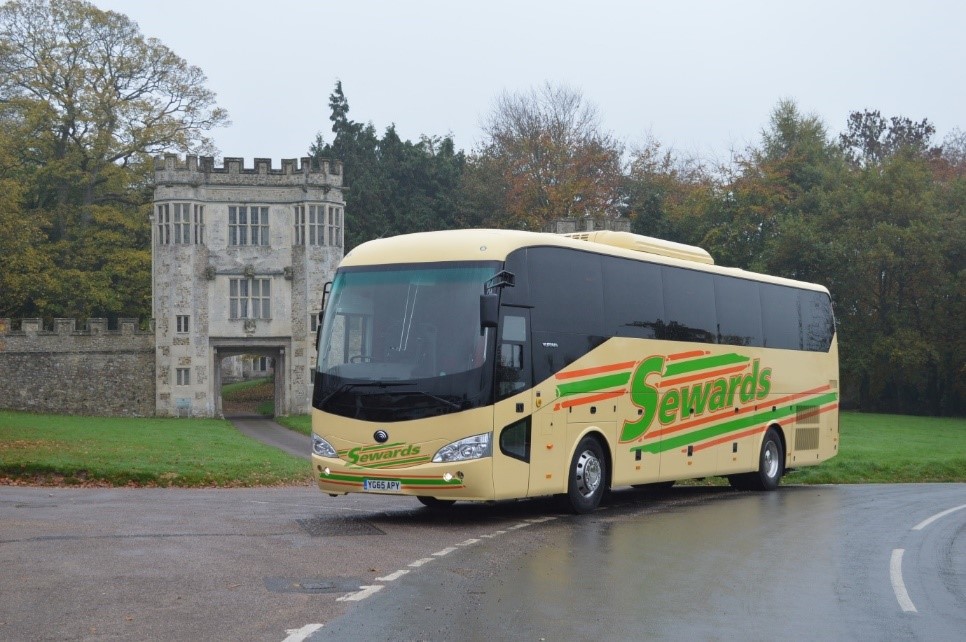
The UK coach industry is a strange and diverse beast. If we exclude the ‘big hitters’ on the express services front, the industry is almost precisely in the form that the late Nicholas Ridley envisaged the bus industry being post-deregulation in that it is principally made up of smaller companies, often family-owned, serving fairly small markets on very tight margins but having intimate knowledge of what they do and who their regular customers are.
While each operator knows what it does, few others do and that is one of the industry’s problems. There is no annual collation of coach data by the Office of National Statistics or the DfT. Coaching lacks the big political clout of a Go-Ahead or Stagecoach, which is why it is so good to see the CPT campaigning on the industry’s behalf1.
Diversity is certainly a trait of the coach business. There probably is no simple answer to the simple question of ‘what does a coach operator do?’. There are those who supply superannuated fleets to ferry schoolchildren to and from school and very little else; there are those who do indeed ‘do’ school transport, but who have different strands of the business built on including the traditional day excursion market, concerts, away matches, private hire, pretending to be trains and what used to be called ‘extended tours’, taking a group away for several days staying overnight in hotels.
There are specialists too, such as those providing very upmarket transport for music groups on tour, anything from Orchestra to Ozzy Osbourne. In recent years, the growth of the cruise ship trade has been intrinsically linked with coaches. Berths for huge ships are seldom in convenient or especially scenic spots. Their occupants want to go places and see things, if necessarily briefly, unless that is, they have a particular penchant for shipping containers.
As an aside, the bus and coach industry might legitimately worry about the point at which passengers will feel safe travelling together but those concerns must be writ large for cruise ships after being described as ‘floating petri dishes for disease’ and so on. It’s difficult to envisage a rush back to cruising.
The rail industry’s recent attempt to make PSVAR provisions apply across the industry at short notice only goes to show that even one of the industry’s biggest customers doesn’t understand it. For one, the coach industry lacks the largesse of franchise payments to fund complete (and probably unnecessary) fleet replacement.
Does this diversity make it difficult to get the coach industry’s message across? Almost certainly yes; and difficult too for the beneficiaries of the coach industry to be fully aware of and measure the value that coaches bring. In particular, what would things look like if there was large scale collapse of coach businesses, which is a very real threat? As examples:
Do tourist hotspots like Windsor or Chester appreciate how much traffic congestion volumes and demand for car parking spaces would grow without coaches?
Do organisations such as the National Trust and English Heritage appreciate what proportion of their income comes from coach parties?
What would happen to accident statistics due to drink driving if every hen or stag party and wedding reception was wholly by car?
Is even the link between the viability of many hotels and coach parties understood?
Who can put a social value on a day trip or short break by coach for someone who otherwise wouldn’t go far or have any holiday?
How many politicians even appreciate that the bus industry and the coach industry are very different beasts indeed?
The coach industry versus the private car is a very similar comparison to shifting freight by rail or road. It makes sense to use one unit to carry lots of things (or passengers) over a distance than in many smaller units, provided you get the end distribution (or assembly) right.
Without coaches I suggest we’re a lot worse off as a nation, where those without cars are excluded from many things, where every tourist hotspot is gridlocked and where the historic approach to any castle, garden or abbey is covered by a sea of shiny metal parked cars.
So good luck to the CPT and here’s hoping the governments in Westminster and the devolved nations come to appreciate the value of the coaching sector.
“Go to work, don’t go to work, don’t use public transport and, er, something else.” So said Matt Lucas in his well-viewed spoof of Boris Johnson’s address to the nation on 10th May. There are times when you just despair and this is definitely one of them!
Let us leave aside that, so we are told, when the PM said on Sunday ‘go back to work tomorrow’, he really meant Wednesday (Monday’s version) and wasn’t in any case expecting a flood of people returning to work (Tuesday’s version). This is about public transport. Just in England. Mainly.
The theory is that people should avoid public transport, but for the few who do use it they should wear face coverings (the word ‘covering’ quickly replaced ‘mask’ as the latter are needed for the health sector), adopt social distancing and services will be increased so that loadings are as low as possible. It’s a surreal World at the moment.
However, despite what elements of the press have reported, PT users have not been ‘told’ to wear face coverings at all. The official words from Downing Street were “It is advice, so we are publishing that today and it is for the public to judge whether or not this is something they want to follow. It is not something that is part of the regulations, i.e. you won’t be fined for not wearing a face mask.” Even British Transport Police is ambiguous: “In line with government guidance, you may see our officers wearing face coverings when on routine patrol. They’ll be wearing them when they themselves feel it is necessary…”
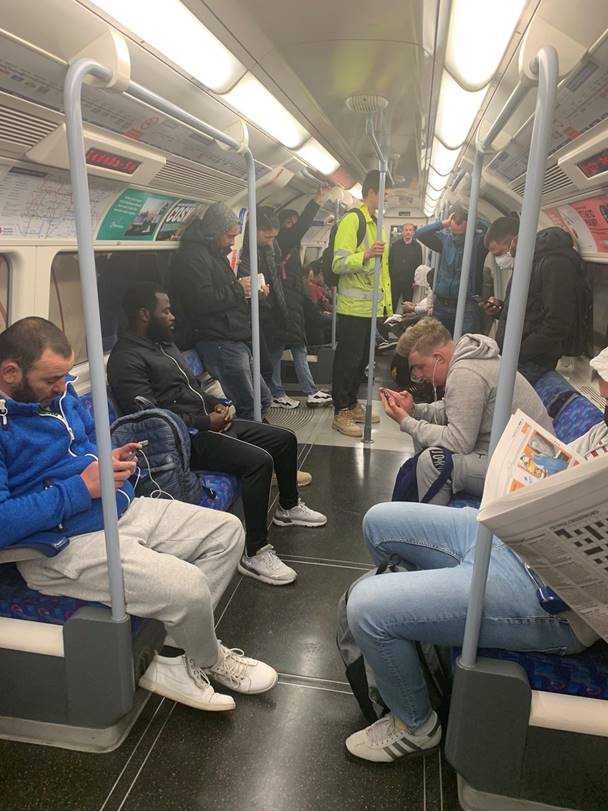
So we know for definite about social distancing at least, don’t we? Monday’s generic 50-page document told us that: “Social distancing guidance on public transport must be followed rigorously.” But that was before the ‘Guidance to Operators [1]’ was published on Tuesday, which was decidedly more ‘elastic’ in its instructions – “There are situations where this may not be possible, for example when boarding or alighting, during security checks, on busier services, busier times of day.”
My interpretation of that is: “Practice social distancing on public transport unless there are too many people on board” or when there is, as Grant Shapps MP said on Tuesday: “the space to maintain social distancing as far as possible.” His colleague Robert Jenrick MP noted today in response to comments about overcrowding (in the Covid era sense) that “You should be taking precautions like social distancing if you can – I appreciate that isn’t always possible and some of the scenes… show buses and Tubes too full to be able to sit two metres apart and that’s a problem.” Problem it may be, but not big on solutions. Boris, so he said, does not want to see crowding on public transport, the cynical answer would suggest he’d achieve that by turning his back.
This is not an issue unique to the UK, of course. Similar issues have arisen in both Australia and Switzerland, while there were complaints in Dublin that passengers were sitting in the seats marked ‘don’t sit here’ intended to maintain social distancing. The Devutopia blog contains a brief and timely explanation of why the rush to buses and the Tube in London has resumed – related to where workers can afford to live in Greater London and why it’s impractical to walk or cycle into the centre [2]. Ironically, because TfL has ceased taking fares in order to protect its staff, it makes bus travel a more attractive option. Out in the real World, as passengers return, drivers in sealed cabs can’t hear what passengers are asking for!
The position on one of social distancing’s sacred cows also seems to have changed in any case. Two weeks ago a senior medic questioned the source and validity of the ‘two metre rule’ and in yesterday’s ‘Guidance to Operators’ we find that “this is not a rule and the science is complex. The key thing is to not be too close to people for more than a short amount of time, as much as you can.” The World Health Organisation has its own guidance [3], based on a ‘one metre rule’, but not once on board. WHO guidance is more stringent on touching surfaces and suggests using a disposable tissue as a barrier, although its advice to ‘avoid touching handrails’ raises other safety implications! Human factors do, of course, come into play too, as Dr Hans Kluge of WHO noted: “Reports of distrust in authorities and conspiracy thinking are fuelling movements against physical distancing, other people are behaving over-cautiously.”
Which leaves the ‘ramping up’ of services. Sending people back to work at half a day or three days’ notice left no realistic time for operators to adjust very much at all, although no doubt it will be all their fault for not doubling frequencies with a click of the fingers. I’ll leave that response to our friends at Nottingham City Transport: “It will take time to implement these requirements and with the majority of our buses delicensed and currently unavailable for use and 75% of our employees furloughed, any changes to service levels are likely to be gradual and in line with the ‘road map’ set out by the Prime Minister.” Nobody can fault the operators for feeling frustrated. I could easily imagine the first draft of that NCT press release being littered with expletives!
There has been the inevitable concentration on events in the Capital, but what of the scores of operators of school contracts across England baffled by the plans for a partial return to school on 1st June, with ‘staggered’ start and finish times. Their buses and staff are probably in a situation akin to those at NCT. It seems social distancing is anathema once in the classroom but not on the transport to and from. How, in three weeks’ time, will every local authority in England sort out staggered, socially-distanced transport for maybe 20% of pupils? If, of course, their parents let them return. This is veering into Cloud Cuckoo Land.
Well before Boris’ Sunday address, Christian Wolmar published his thoughts on post-lockdown public transport [4] where he concluded that policing numbers on peak hour trains or the Tube was simply not practical. I agree – and I add buses to that conclusion. Who is around to supervise numbers in all carriages of a twelve car Thameslink train staffed only by a driver ‘up front’? What bus driver in charge of a 75-seat double-deck with only twenty ‘socially distanced’ seats is going to risk a confrontation with passenger number twenty one who wants to get on? Will the granny with her shopping be told she can either go upstairs or wait half an hour for the next bus when there are empty seats downstairs? Will he or she really get out of the cab and go upstairs to say ‘you can’t sit there’? Of course not and moreover, we should neither ask, nor expect them to.
We have a classic clash of remote theory with on-street practicality. Home-working, ‘Zoom’ broadcasting theorists saying a bus has only 15% of its pre-Covid capacity when it blatantly hasn’t. What use is saying ‘don’t use public transport’ when urban society depends on it to function? Fundamentally, public transport and social distancing are incompatible. We should accept it and live with it – as indeed lots of urban dwellers seem to have done this week, whether willingly or not. If this is too risky then there should be no return to even partial ‘normal life’. Mister Reality needs to be brave enough to stand up and say so.
/by Steve Warburtonhttps://taspartnership.co.uk/wp-content/uploads/2018/02/image001.jpg811608Steve Warburtonhttps://taspartnership.co.uk/wp-content/uploads/2026/01/The-TAS-Partnership-Logo-Horizontal-Small-e1567169834623padding.pngSteve Warburton2020-05-14 15:30:422020-09-01 16:33:26Will Mister Reality Stand up and be Counted?
Getting Passengers Back on the Bus – A Team Effort
By Matthew Moll
The Government, politicians and civil servants should do all they can to get people back on buses as soon as it is safe for social distancing to be relaxed. Recent surveys have shown that previous public transport users with a car are more likely to use it instead of the bus, whilst those without are often managing to get by thus forming a habit of not travelling by bus. However buses are economically important allowing people to access employment, health, education and leisure opportunities whatever the weather, alongside creating direct and indirect employment themselves. There will be a lot of work to undo the message currently being distributed of “don’t use public transport” which is set to continue when lock down eases.
Here are three ways that it can be achieved.
1 – Be on message with the industry
Yes, we should continue to be able to have the debate about how buses should be run and who should own them but in the right way at the right time. Those who have spent the last few years constantly bashing the bus (including many media outlets) should join with groups such as CPT, Campaign for Better Transport, Greener Journeys and Bus Users UK to get a consistent message out that says buses are safe to use again.
2 – Get on the bus to reassure people
It is perhaps a sad reflection of the times that being on public transport is seen merely as a photo opportunity by politicians rather than normality. However in the post COVID-19 world this is actually a good thing. Politicians both national and local along with celebrities need to be seen to be endorsing public transport use. Some of the major operators have recently used local and national media personalities to encourage people to become bus drivers meaning they already have a first port of call to get the ball rolling.
3 – Bring back the new bus fund
Stagecoach recently announced it has cut back its Capital Expenditure budget for the 2020/21 financial year including delaying the new coaches for the Oxford Tube. We have to be careful that by the time operators feel ready to invest again in new vehicles we haven’t lost some of our manufacturers. At the same time a new bus launch is always good publicity for an operator and an easy photo opportunity for politicians, especially if they’re able to say they helped fund the fleet. Getting new buses on the road as soon as possible will help reduce pollution and ensure that the image of the post COVID-19 bus industry is one of confidence in the future rather than just scraping by (even if that is what is actually happening for the first year or two). This is different from any green bus fund with a focus on Euro VI buses but with the idea of the DfT covering the cost of 50% of a new vehicle and even a loan for the other 50%.
Summary
I have full confidence that bus operators will do all they can to try and get passengers back on the bus, even those that aren’t perhaps known for their marketing prowess at the moment. However, without the backing of figures in the public eye, it will be very hard to convince a public that has been told not to use public transport that it is safe to do so again.
/by Matthew Mollhttps://taspartnership.co.uk/wp-content/uploads/2018/02/Preston-Bus-Station-Solo.jpg434640Matthew Mollhttps://taspartnership.co.uk/wp-content/uploads/2026/01/The-TAS-Partnership-Logo-Horizontal-Small-e1567169834623padding.pngMatthew Moll2020-05-06 14:32:402020-09-01 16:33:14Getting Passengers Back on the Bus – A Team Effort
Politicians Might Get What They Want But No Longer Want it – The Future of the Bus Industry
Matthew Moll
No one can be certain what the outcome of the Coronavirus will be on British Society and the Global Economy. We don’t know yet when we will next be able to watch live sport, visit the cinema or go to the pub. It isn’t even clear when schools and universities will reopen. A large proportion of the population is now working from home and whilst some will be glad to go back to their office when it is all over, others may stay at home even if just for part of the week. Will people flock back to the high street, cinemas and nightlife or will this be the final nail in their coffins?
All this will have an effect on the future of the bus industry and will probably null and void the DfT’s National Bus Strategy. Franchised Train Operating Companies are now all operating on management contracts and if the DfT has any sense it will use this opportunity to implement the restructure of the rail industry. But will the same happen for the bus industry?
One scenario is that some near normality is restored and patronage bounces back. The likely impact will be the use of the money set aside by the DfT for Electric Bus Towns etc. to instead compensate bus operators for the loss in revenue. This will mean the structure of the bus industry stays the same but the money earmarked for boosting patronage will no longer be there. Local Authorities are likely to have little spare cash to spend on improving bus priority measures and infrastructure whilst operators might be less willing to invest in new vehicles given their financial position, indeed both First and Stagecoach have already said capital expenditure is likely to be the first casualty of the current crisis. This will mean the continued overall decline in long term bus patronage and, indeed, in the manufacturing sector.
We might hope for another ‘post-war’ boom with a surge in ridership as people are no longer constrained. At the other extreme we might have an industry on its knees with only a proportion of pre-crisis patronage returning. Even if 80% of the patronage returns it will have a massive impact on the future sustainability of the bus industry. This could result in the view of operators to franchising changing, the big groups might start to support the plans of the Metro Mayors and others to take over control of the network. It would mean that instead of fighting for survival as traffic generators fail to return, they could get a guaranteed profit margin and let the Combined Authorities worry about the lack of passengers and revenue. And for Andy Burnham and co. a success as they take back control of the bus industry without opposition, but would they still want it?
If the traffic generators for bus fail to fully return it is likely that this will be mirrored on the other forms of local transport. Would GMCA want to carry the burden of supporting the bus network whilst having to deal with a lack of passengers on Metrolink?
Beyond this there is talk of nationalising the bus industry if only temporarily. Running all services as contracts whereby the government pays for any operating loss makes sense whilst they are telling people to avoid public transport if possible. After all, the vast majority of operators don’t have deep enough pockets to keep funding running empty buses around all day. Without government support, if operators are forced to reduce services to skeletal levels then key workers will find other transport and never return. The problem is what happens at the other end. Will some areas need to stay like this longer than others? Will politicians attempt to get involved and argue that since the services are currently de facto franchised why don’t they stay that way?
So what should be happening now? Operators themselves will no doubt be too busy with day to day issues of providing a service to ask directly, however CPT, ALBUM and the higher echelons of the groups should start now by drawing up together a set of scenario outcomes and responses. The CPT has indeed already been making the right noises about the need for support from government. A proactive industry is more likely to survive this crisis in some shape or form than a reactive one.
/by Matthew Mollhttps://taspartnership.co.uk/wp-content/uploads/2018/04/Default-Thumbnail.jpg7991205Matthew Mollhttps://taspartnership.co.uk/wp-content/uploads/2026/01/The-TAS-Partnership-Logo-Horizontal-Small-e1567169834623padding.pngMatthew Moll2020-03-26 10:28:332020-03-26 10:31:23Politicians Might Get What They Want but No Longer Want it – The Future of the Bus Industry
The rare opportunity to announce measures that benefit motorists is understandably seized upon by vote-hungry politicians, and so it is no surprise that a 2019 Conservative election pledge to abolish car parking fees at hospitals was widely reported. And with the resounding return of another Conservative administration, we can expect the bulk of the manifesto promises to come to fruition – including the proposed policy on NHS parking. But will motorists feel any benefit? Moreover, is the policy really new?
The NHS is a regular hook upon which pre-election promises by all parties are hung to reassure the voters that the institution is secure and “in safe hands”. This almost always comes down to money, of which the Conservatives were pledging an extra £34bn per year.
The manifesto stated that: “We will end unfair hospital car parking charges by making parking free for those in greatest need…This will eliminate costs for those in need, while making sure there are enough spaces for everyone.” Those in ‘greatest need’ are in fact the minority of hospital car parkers – most people will still have to pay the prevailing tariff.
And voters in Scotland and Wales have heard all this before – ten years ago. Welsh hospitals have theoretically offered free parking for all since 2008, although that policy took ten years to be fully implemented. Scotland has been somewhat in abeyance with some sites already offering free parking but others still charging due to being locked into long term contracts with car parking providers which are too expensive to buy out of.
That it is also unfair for those needing to reach the hospital where there happens to be an inadequate bus network was not alluded to directly in the Conservative manifesto. Buses, however, are to be subject of some upgrading and improvement measures, with the bold assertion that city regions will be funded to “upgrade their bus, tram and train services to make them as good as London’s.” As the majority of NHS sites are outside the city regions, we can assume that bus service links to many hospitals will not benefit at all.
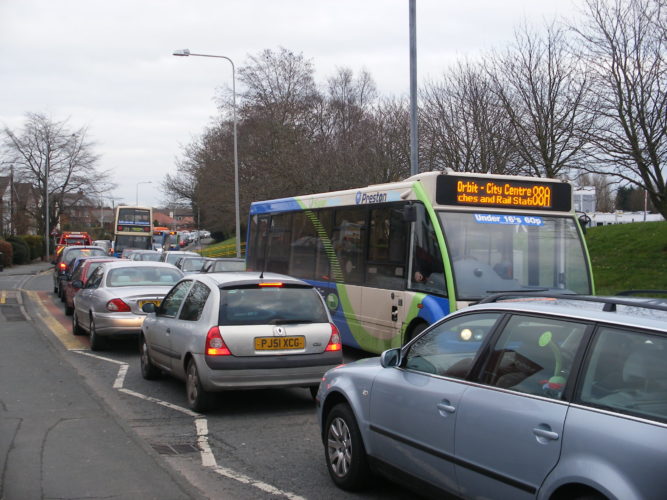
Buses in traffic on Sharoe Green Lane outside Royal Preston Hospital
Fundamentally, encouraging more cars can only mean increased congestion, which will further retard the efficiency and attractiveness of those current bus services serving hospitals. And at the sharp end of the hospital access priority, more cars will have the effect of delaying ambulances which directly compromises healthcare standards.
In reality the plan is to offer free parking as a concession to specific qualifying patients, visitors and staff. And if this move is seen as creating more demand for the already inadequate parking space provision at most hospital sites, an additional capital investment is promised to create more car parks, whether or not the surrounding road network is able to handle the additional traffic.
A less reported detail (although clearly stated in the easily-overlooked manifesto annex document ‘Costings’) was the cost of the ‘free’ parking over four years: £384m revenue + £257m capital to build the new car parks. This amounts to £641m over four years – or, to use a popular illustrative comparator, the equivalent cost of 4,000 additional nurses (at £40k per year).
This reflects a more holistic, multi-modal approach to alleviating parking and improving access to hospitals that is lacking in the Conservative manifesto.
It is interesting to compare the policy on car parking that has been in place for at least five years with the 2019 manifesto pledge.
2015 Directive to NHS Organisations
2019 Manifesto Pledge
“Concessions, including free or reduced charges or caps, should be available for the following groups:
disabled people
frequent outpatient attenders
visitors with relatives who are gravely ill, or carers of such people
visitors to relatives who have an extended stay in hospital, or carers of such people
carers of people in the above groups where appropriate
staff working shifts that mean public transport cannot be used.”
Free parking “for those in greatest need, including:
disabled people
frequent outpatient attenders
parents of sick children staying overnight
staff working night shifts.”
This 2015 list of parking concession beneficiaries would appear to be the exact groups that the 2019 manifesto is seeking to help, which suggests that there is already an active policy to offer free or subsidised charge parking to those most in need. So what in the manifesto is new? The somewhat emotive reference to “parents of sick children” (children of sick parents could be equally deserving) and “free” has replaced “free or reduced”. It is reported that many NHS Trusts have not implemented the 2015 policy, and over 150 sites are said to even levy charges on Blue Badge holders. So maybe the Conservative pledge is not so much a new policy but an effort to make an old policy work properly.
The £384m cost is presented as an additional budgetary allocation, which might be taken up with the concession or used to plug the gap in revenue loss – but if the policy is already in place, is this much new cash is actually needed? It could also be, as was the case in Scotland, that long term private sector contractors of parking services would have to be compensated.
The £257m capital for additional car parks is new money, however, and would appear to be made available to dispel the obvious retort that more parking spaces are needed, not free parking spaces. This shows that an increase in car journeys is anticipated – the particulate emission and congestion costs of this increase, of course, aren’t factored as a financial debit. ‘Smoke free’ hospital sites apparently don’t include vehicle emissions. Local Councils struggling to meet air quality targets might be expected to take a dim view of this. But how much more valuable would have been a £257m investment in bus priority and infrastructure enhancements at hospital sites instead?
Finding the space to accommodate more cars will be less easy. How many hospital sites have the elbow room to expand on-site parking? Can existing multi-storey car parks be elevated further with additional levels? James Cook Hospital in Middlesbrough, for example, has some adjacent sports fields. Ditto at Cheltenham General Hospital which abuts the open green space of Standford Park (part of which has already been purloined for a helicopter landing site). Are these precious amenities to be sacrificed in the roll out of the policy? Hospital sites have developed incrementally – new units and facilities are squeezed into available space over time, and many hospitals have long ago fully exploited the limits of their geographic boundaries. Many already rely on satellite parking areas that require shuttle buses or Park and Ride (if you’re lucky) or long walks (if you aren’t). So in practice, buses will have to figure in any solution to the parking problem, because in likelihood new car parks will not be near enough to allow walking access to the hospitals.
There are 1,250 hospitals in the UK and an equal split of the whole budget would provide £128,000 per year per site, which could be used to improve bus services and bus priority access arrangements but is admittedly a small sum with which to make an impact. An equal split of the capital alone for new car parks would yield a mere £206,000 per site which would provide very little indeed. But the allocation could be targeted at, say, 250 hospital sites which have a critical problem, with a much more potent £641,000 per year to play with. In Preston, for example, the junctions that serve the Royal Preston Hospital and some of the main A6 route north of the town centre are heavily congested – cars, buses, and ambulances are equally retarded, especially at peak times. Creating an effective Park & Ride scheme in the North of the city could help to resolve this.
Some examples of hospitals with ongoing transport and access problems:
Sheffield: Access into the Northern General in Sheffield by bus has always been problematic. It is a massive site but a significant walk from the main volume of buses on Barnsley Road. Last September First changed one of its Barnsley Road routes – the 11a – to go into the hospital site, offering a fifteen-minute headway direct from the city centre. However, First has now told its users that “buses are temporarily suspended from directly serving Northern General Hospital as permission has been refused to use the hospital grounds.”
Barnsley: “South Yorkshire’s Active Travel Commissioner has been invited to help find solutions to traffic congestion around Barnsley Hospital which has left air pollution in the area nudging dangerous levels. Councillors representing the area have already suggested a park-and-ride arrangement as a means of reducing traffic…but no progress has been made with those ideas.” (see – Yorkshire Post 9th September 2019)
Wrexham: An independent report at the Wrexham Maelor hospital site found that “of the 1600 parking spaces available at the hospital… peak times demand for space can exceed those spaces by around 10%. Roll forward three years to April 2019 when it was confirmed by Betsi Cadwaladr that several options had been put in place and other were being looked at – including increasing the car parking capacity at the site. A spokesperson for the health board said: “We’d urge anyone visiting Wrexham Maelor Hospital to factor the potential traffic congestion during peak hours. We understand that parking is a challenge on site, and have made efforts to ease pressures, including introducing a drop-off area and promoting alternative travel arrangements to the site, such as cycling and car share schemes.” (see – wrexham.com – 13th January 2020)
Substantial allocated funding to apply to all aspects of transport and access (and not just car parking) could go some way to alleviating the problems noted above.
More useful, perhaps, would be measures to ensure that the NHS does engage properly with patients and staff, local authorities and public transport providers (as the 2015 directive expects) and
a) produce a travel plan for its hospitals that encourages sustainable modes and
b) ensures that the plan is made to work.
Undoubtedly, the car parking arrangements at many hospitals are dire and can no doubt be improved, but this should not happen at the expense of bus users, cyclists and pedestrians.
TAS Partnership has worked with a number of NHS bodies to improve site access and it will be interesting to see how the new financial allocation (which kicks in from April 2020) works out. If the car priority is allowed to prevail, then the demand for parking will even further outrun supply (new car parks notwithstanding), and visits to hospitals will become even more of a nightmare.
/by John Atkinshttps://taspartnership.co.uk/wp-content/uploads/2018/02/NHS-Parking-Photo.jpg548800John Atkinshttps://taspartnership.co.uk/wp-content/uploads/2026/01/The-TAS-Partnership-Logo-Horizontal-Small-e1567169834623padding.pngJohn Atkins2020-03-20 17:35:212020-03-20 18:32:14Hospital Car Parking – Is there Room for the Bus?
Bus franchising is hot on the agenda, but could the approach be better thought through?
TAS Senior Consultant, Matthew Moll mulls over the implications of GMCA’s proposed approach on franchising and considers an alternative approach of a shared risk partnership
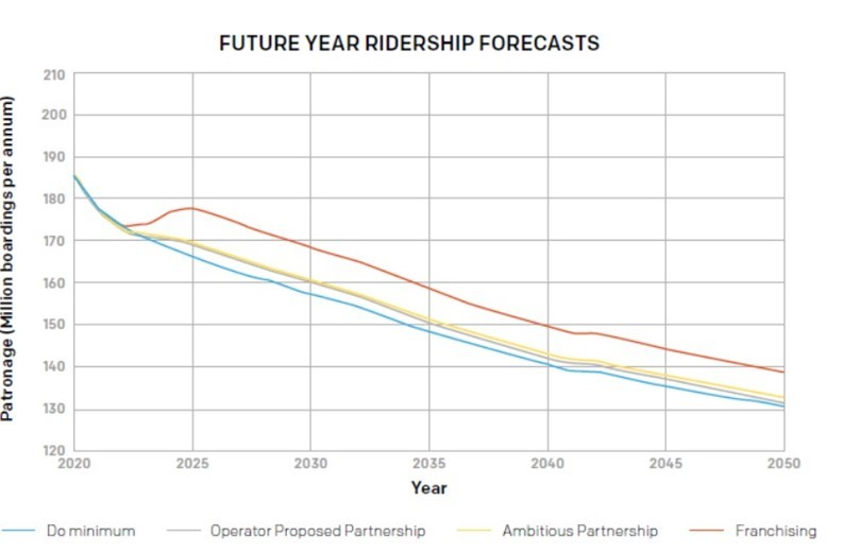
After being told countless times that franchising is the only way forward for buses, I was a bit taken back at the graph in Greater Manchester Combined Authority (GMCA) consultation which clearly demonstrates the significant patronage decline under a franchised regime that is anticipated. Yes, there will be the initial bounce or rather increase, like a new manager taking over a football team (with its associated costs), but the poor form soon returns. So is it really worth getting rid of the existing manager? Throwing money at a problem for an initial gain but no actual solution feels endemic of modern leadership, but when it comes to our public transport network or any fundamental national infrastructure, can we afford to let the ‘look what I achieved in a few years, now I am off to do something else’ approach fly?
The glut of manager changes in the Premier League in November and December is timed to allow the new manager in charge to shop for new players who will hopefully bring a lasting change in performance to the January transfer window. GMCA’s equivalent, taken from their consultation ‘Doing Buses Differently’: “Further investment to improve the quality of the system is likely to be required to help stabilise the market. This further investment is collectively referred to as ‘Phase 2’ interventions and does not have committed funds at this time.”
This intended second phase of funds for the franchised network is telling! A very public emphasis on the affordability of franchising and how little tax payers will have to contribute to create a world class bus service has been prevalent. However, how likely is it that the second phase of interventions actually involves tax payers having to stump up extra cash? Also what is the strategy: what could these interventions be and what effect would they have? And why can’t they be planned for or undertaken now? There are three main options as far as I can see.
Fares reduction – Reducing fares (or making the bus ‘more affordable’ as some see it) is a political winner, just like signing the on form striker – however like that striker it comes with a hefty price tag. Greater Manchester Mayor Andy Burnham has cited the benefit of £1.50 flat fare on London’s buses in the past. Research for TAS’s National Fares Survey 2019 shows the average single fare for a three mile journey in Greater Manchester to be £2.73, but we’ll say £2.70 to keep it simple. Dargay and Hanley (1999)[1] give a bus fare elasticity factor in metropolitan areas as -0.21 in the short term and -0.43 in the long term.
Put simply, for every 100 passengers at present, the fare reduction will attract nine more in the short term and a further ten (19 overall) in the long term. This means that whilst those 100 passengers at present generate £270 of revenue, in the short term the 109 will generate £164 and the 119 in the long term £179 giving an overall revenue reduction of 39.3% and 33.8% respectively.
Frequency increases on key routes – If it isn’t cheaper, then it’s got to be better, a more frequent service tends to be the number one demand. This is slightly ironic given that GMCA have identified six of the heaviest used corridors in the Greater Manchester area as being ‘over bussed’. Balcombe et al (2004)[2] state that changes to bus service frequency have an elasticity of 0.38 in the short term and 0.66 in the long term.
If we take Stagecoach service 9 Wigan – Leigh – Higher Folds as an example. This currently runs every 12 minutes Monday to Saturday daytime with a Peak Vehicle Requirement of 10 Enviro 200 midi-buses. Increasing the frequency to every 10 minutes would thus increase patronage by 7.6% in the short term and 13.2% in the long term. However the cost would increase by 20% for the two extra vehicles alone, without taking into account the extra driver, fuel and maintenance costs.
Reduced Journey Time through Greater Priority – Arguably one of the best ways to boost public transport use is to get motorists out of their cars and using it out of choice rather than necessity. Bus priority over cars through major junctions and more direct routes to reach traffic generators is key to this. This would also help environmental performance as fewer cars on the road will create less pollution. It is understandable that highway authorities might be more willing to invest in bus priority if the state sees a financial benefit from it, rather than this solely going to private operators. The operator would generally see a double benefit through increase in patronage and reduction or at least stabilising of resources needed to provide a service.
Balcombe et al (2004) quote a journey time elasticity of -0.4 to -0.6, say -0.5 as a halfway house. Service 163 takes up to 71 minutes from Heywood to Piccadilly Gardens in the morning peak and 52 minutes in the off peak. Reducing the peak journey time by 10 minutes would increase patronage by 1.07% whilst matching peak to off-peak running time would increase patronage by 1.13%. That might seems small however it is likely that the resource saving in the latter scenario would allow the peak frequency (currently every 12 minutes) to match the off peak frequency of every 10 minutes, which as shown earlier would see a further patronage increase of at least 7.6%.
Sharing the Risk and Reward
So if phase 1 of franchising isn’t going to reverse patronage decline in the long term but will still cost £134.5m by 2025, is there a better use for the money? Could you keep the same manager and spend the money saved on redundancy and attracting a new boss on new players? In this scenario commercial operators would then continue to use their decades of experience to provide a largely deregulated service, potentially under an Enhanced Partnership framework, or another model not yet considered in the debate. One that allows Transport for Greater Manchester (TfGM) to have a say on the quality and level of service provided. But how would you do that?
Low Fares – As part of its ‘A better deal for bus users’ published September 2019, the Department for Transport (DfT) states that: “The government is actively looking to work with local authorities and operators to identify ways to encourage operators to implement multi-operator tickets and fares caps, either in relation to the price paid for individual journeys or a daily or weekly cap.” Given that GMCA’s plan for fares under franchising would see the multi-operator System One product reduced to the same price as the current cheapest operator only network product it would seem sensible for this to be undertaken as part of the DfT trial before a potentially irreversible alteration to the current system is made.
Increased Frequency and Reduced Journey Time – These are best dealt with together as reducing the journey time can make increasing the frequency more viable, especially where there is a partnership approach between the operator(s) and local transport authority. However the commercially viable frequency may not be up to the level that GMCA or TfGM wish.
The key part of either an Advanced Quality Partnership or an Enhanced Partnership is that operators sign up to provide a certain quality of service in exchange for infrastructure improvements. However it still relies on the service being financially viable for the operator thus, as shown with service 163 earlier, a frequency of every 10 minutes all day might be the limit of what is a sustainable level of resource commitment.
However using a de minimis contract TfGM could pay the operator (currently Diamond Bus North West) to provide a frequency of every 8 minutes all day; the de minimis contract covering the cost of the extra resources required. The contract could be reviewed every year with a target patronage level growth set around 7.6% in the short term and 13.2% in the longer term. If the target is exceeded the de minimis payment would be reduced. This means the revenue and cost risks are shared.
Conclusion
As with any manager under fire it seems like the whole world is against them. In Greater Manchester the local media has come down on the side of the pro-franchising politicians and it seems that no one supports the existing set up. This is understandable considering even the government bastions of free enterprise seem to support franchising for political rather than ideological reasons. But can that change? Some football managers have seen a good run of results just at the right time to save them and crucially save their club some money which could be better spent on players.
The aim of my suggestions (a partnership between commercial operator and Local Transport Authority where the risk and reward of lower fares, higher frequencies and more bus priority are shared between parties) is to show that there is another way to attempt to reverse a critical aspect of the poor form without changing the manager. If implemented properly it could deliver service improvements that people want and save the council tax payers of Greater Manchester the cost of franchising Phase 2.
This of course only covers a small aspect of the franchising debate. In the end if GMCA and, crucially, the tax payers of Greater Manchester are willing to pay for it then franchising can be a success. However the aim of this article is to point out that there is a more affordable way to meet many of the goals of franchising bus services.
[1] Bus fare elasticity, a report to the Department of the Environment, Transport and the Regions
[2] The Demand for Public Transport: the effects of fares, quality of service, income and car ownership
/by Matthew Mollhttps://taspartnership.co.uk/wp-content/uploads/2018/02/33914448650_4a6c6328b7_k-e1580134263663.jpg10001333Matthew Mollhttps://taspartnership.co.uk/wp-content/uploads/2026/01/The-TAS-Partnership-Logo-Horizontal-Small-e1567169834623padding.pngMatthew Moll2020-03-20 16:50:002020-03-20 18:33:38Bus franchising is hot on the agenda, but could the approach be better thought through?
How often do we bemoan the lack of coordination between land use planning and provision for public transport? Here at TAS, and for many of our clients, it often provokes nothing short of utter despair at times.
Well, let me take you off to the western edge of Inverclyde. Way back in 1951, an outfit specialising in office machinery called IBM opened a factory alongside the A78 just beyond the western fringes of Greenock in the delightfully named Spango Valley. Over time, the factory grew as IBM became the computer-producing megalith we all know and also inevitably, it progressively transferred its production overseas and finally left the site in September 2016, although it retains a presence in Greenock.
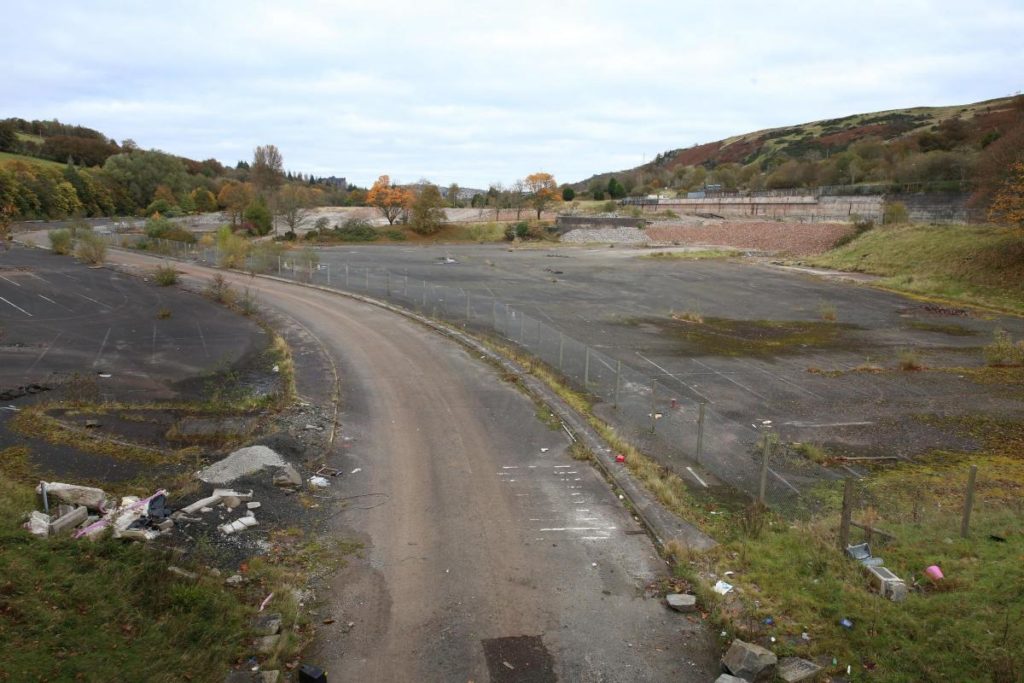
Spango Valley Currently
Transport provision adapted slowly. The railway got around to opening a halt on the Wemyss Bay line (named IBM) in as little as 27 years. The highway engineers took only slightly longer to turn the main A78 past the site into dual carriageway in the early 1980s, which also catered for heavy traffic to Inverkip Power Station, which has also since closed. In response to the almost totally derelict site and average patronage of two passengers per day, Scotrail withdrew its service at IBM in December 2018. In a vain effort to attract new tenants, the site was rather uninspiringly renamed ‘Valleypark’.
The main IBM office block and main entrance were close to bus stops on the A78 served by four buses an hour each way, two each of McGill’s and Stagecoach, but the dualling of the road turned pedestrian access to and from Greenock-bound bus stops into a ‘take your life in your hands and run’ manoeuvre, twice, interrupted by a spell in the narrow central reservation. (Try Google Streetview and search IBM Factory Stop ID 46823528 to see for yourself). Given its size, there were once probably ‘specials’ that ran into the site at works times but my local knowledge fails at that point.
So forward to December 2018 and the news that the site had been sold for redevelopment and in October of last year ‘Inverclyde Now’ reported that the new owners were none other than the Easedale brothers, owners of local bus company McGill’s[1].
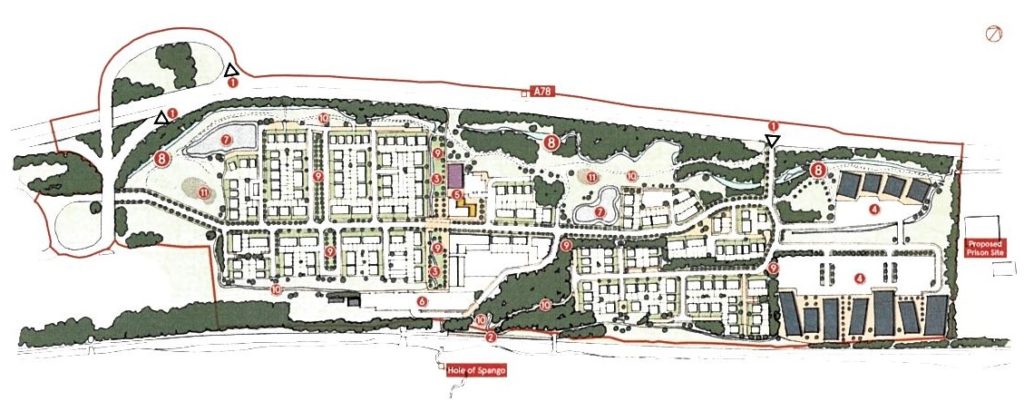
The report included a map of a mixed use sustainable development including a residential development for 1,000 people with its own ‘village centre’. It also includes, so the story reported rather irresistibly, a “de-culverted and daylighted” Hole of Spango. Public transport is addressed by a proposed Park and Ride site at a properly functioning IBM halt. Knowing how long the railway takes to reinstate anything, good luck with that one. No apparent mention of buses, but maybe the owners have more interest in promoting the half hourly ‘Clyde Flyer’ to Glasgow than the Scotrail offering.
Spango Valley Development
But what a dream combination this is – site developer and bus operator in the same ownership. The site plan shows a nice through road east to west across the site with none of the sharp radius twists we have come to expect and detest in new developments. Can we take it then that bus provision is assumed from the outset? We wish it luck now that the full planning application has been submitted.
How nice it would be for new occupiers to be enticed by a free month’s ‘GoZone’ smartcard, promotional material or even an invitation to one of McGill’s’ tea dances! Is the idea of an entry by smartcard luxury waiting lounge too much of a step into fantasy?
Looked at the other way round, the presence of ‘Clyde Flyer’ – a thriving, quality operation by anyone’s measure – must surely be a selling point for the dwellings themselves. Twenty five or so miles to Glasgow, fight your way along the Port Road, then the M8, tackle city centre traffic and pay for all-day parking or £33.50 a week to be chauffeur driven almost from your door?
It’s perhaps a shame that there isn’t more of this. Bus operator as property developer sharing the spoils for long term mutual benefit. Or even working together. Even more of a shame that in many cases the two don’t even communicate. Worse still the feeling that developers not only don’t think seriously about bus provision but actively don’t want the nasty big things anywhere near…
/by Steve Warburtonhttps://taspartnership.co.uk/wp-content/uploads/2018/02/Spango-Valley-Now.jpg8001200Steve Warburtonhttps://taspartnership.co.uk/wp-content/uploads/2026/01/The-TAS-Partnership-Logo-Horizontal-Small-e1567169834623padding.pngSteve Warburton2020-03-20 16:20:002020-03-20 18:35:01Golden Opportunity in Spango ValleyScroll to top
This is a notification that can be used for cookie consent or other important news. It also got a modal window now! Click "learn more" to see it!
We may request cookies to be set on your device. We use cookies to let us know when you visit our websites, how you interact with us, to enrich your user experience, and to customize your relationship with our website.
Click on the different category headings to find out more. You can also change some of your preferences. Note that blocking some types of cookies may impact your experience on our websites and the services we are able to offer.
Essential Website Cookies
These cookies are strictly necessary to provide you with services available through our website and to use some of its features.
Because these cookies are strictly necessary to deliver the website, refusing them will have impact how our site functions. You always can block or delete cookies by changing your browser settings and force blocking all cookies on this website. But this will always prompt you to accept/refuse cookies when revisiting our site.
We fully respect if you want to refuse cookies but to avoid asking you again and again kindly allow us to store a cookie for that. You are free to opt out any time or opt in for other cookies to get a better experience. If you refuse cookies we will remove all set cookies in our domain.
We provide you with a list of stored cookies on your computer in our domain so you can check what we stored. Due to security reasons we are not able to show or modify cookies from other domains. You can check these in your browser security settings.
Other external services
We also use different external services like Google Webfonts, Google Maps, and external Video providers. Since these providers may collect personal data like your IP address we allow you to block them here. Please be aware that this might heavily reduce the functionality and appearance of our site. Changes will take effect once you reload the page.