☰ Menu

First of all we hope that all our friends and colleagues across the UK and around the world can stay healthy during this unprecedented emergency. We are thinking of you.

Here at TAS we have the ability for all our staff to work from home whilst securely accessing our data and emails, so we do not anticipate any break of service. Calls to our landline are diverted to mobiles as necessary. We will maintain usual office hours.

We are in regular discussion with our local authority and operator clients about the new challenges that they are facing on a daily basis and have been assisting with ideas for changed policies, services and resource prioritisation as well as by drafting new procedures to help frontline staff. We have a particular interest in helping ensure that access opportunities are maintained for older and more vulnerable passengers or are replaced with alternative delivery and visiting services.

The simple message is that we are here and fully functional and available to help you.

In the coming days we will be putting more information on our website covering Covid-19 issues and look forward to hearing from everyone with the challenges and successes of overcoming the threat that this virus constitutes.


© Copyright The TAS Partnership Limited 2016 The TAS Partnership Limited, Guildhall House, 59-61 Guildhall Street, Preston, Lancashire PR1 3NU | Tel: 01772 204988 A limited company registered in England and Wales Number 2929880, at the above address. Cookies on our websites: We use cookies to ensure we give you the best experience on our website.

☰ Menu

The DfT bus funding announced on 6th February didn’t quite match up to the many predictions stimulated by the drip feed of advance notice leaks, not least that what is offered doesn’t add up to the promised £220m, but it was close. It is, at last, an acknowledgement that some revenue funding for the bus industry is merited. All funds available apply only to England outside London.

TAS can offer project or bid development working either on an arms’ length basis or, for long-term success, in a team with local authority officers and operator managers.


The Electric Bus Town looks very challenging as we read it that ALL scheduled services in the designated town zone will need to be zero-emission and ALL operators must sign up. It would only seem to suit an urban area / market town with a single operator of a town service network, with a limited number of interurban services coming in. It is not clear whether all school services within the zone would also be expected to be electric or hybrid. Submissions have to be made by 30 April 2020 to be awarded ‘Summer/Autumn 2020’:

  • It will require significant matching investment – the fund only covers 75% of the difference in vehicle costs and 75% of infrastructure costs. However, depending upon the available electricity deal, it might well allow for quick repayment through cheaper fuel costs
  • The town chosen must have an air quality problem,
  • The size of fleet must fit within the £50m (or lower) budget
  • Significant investment in bid development is also required

The limitations set out here seem to severely restrict the potential number of applicants. Perhaps this reflects a misunderstanding of local bus markets and how they work and that they aren’t a series of standalone islands of operations.

This is partly about technical issues (choice of infrastructure, impact on grid, agreement with power suppliers, structuring the finance and asset risks, etc.) which we can handle through our experience of working with EV operators, combined with our specialist environmental fleet associates. But more importantly it is about leverage of the concept within the chosen location(s) to gain patronage through modal shift, which will require a marketing partnership as well as political leadership where this may be associated with a CAZ with restricted or expensive access for unclean vehicles. We can call on our experience of developing bus partnerships to assist.

Apply for the all electric bus town scheme (gov.uk)


Superbus funding is for designated urban areas with population over 75,000 and in the top 75% of deprived areas, with a submission date of no later than 30 April 2020 and awarded ‘Summer/Autumn 2020’. The focus is on bus priority infrastructure and other measures, with an associated fare cap and undertaking to increase frequencies on specified routes.

The DfT is looking for ‘big projects’ with a minimum of £10m funding.

  • Each LTA can only submit one bid;
  • A Superbus scheme must be delivered through an Enhanced Quality Partnership applying for five years;
  • Priority will be given to high fare areas (high fare is not defined) or areas which have had above average fare increases in the last five years;
  • And areas where patronage has persistently declined over the last three years;
  • And where general traffic speeds have shown a persistent downward trend over three years;
  • Must have firm commitment at member level and support from local bus operators;
  • Areas with existing bus partnership arrangements are ‘at an advantage’;
  • Must be sustainable after year five;
  • The nature of the fare cap is not defined. It could be simple and not necessarily involve complex electronic fare capping;

Must have a ‘robust monitoring and evaluation system’.

In many ways this funding is public recognition of the gospel that TAS has been preaching about congestion being the key factor that puts passengers off. Delay and unreliability are perceived as bigger turn-offs than stated frequency or fare levels; a combination of progress on all three is a pre-requisite to significant patronage growth. Given the climate change crisis, this isn’t a matter of ‘if’, it is a matter of ‘when’. Any major location that isn’t planning for at least a 25% patronage growth on its major bus corridors simply isn’t taking the issue seriously, and the politicians, planners and operators should be called out accordingly.

Success here will require a combination between a robust analysis of corridor commercial performance, scrutiny and appropriate mitigation for congestion delay points, ability to develop integrated fares offers and broad level partnership, project and business development skills. Plus the ability to tell a good story! We wrote the updated Best Practice Guidance on Bus Partnerships for the DfT three years ago – in this we worked hard to stress local authorities’ key role in ensuring that neither State Aid issues, nor the Competition & Markets Authority need to be seen as a problem, and to identify and emphasise the positive ways in which bus partners can generate trust, create added value and reinforce this by celebrating publicly.

Apply for the superbus fund (gov.uk)


Supported Bus Services in 2020-21 This funding can only be guaranteed to be accessed if a planned and detailed commitment is submitted by 13 March! There is an alternative June submission date with funding available ‘later in the year’ but no guarantee that late bids will be fully funded. It is of note that where a shire authority is part of a combined authority then it is the combined authority which is offered this funding, rather than the local transport authority which reduced the bus budget in the first place.

The funding cannot be spent on infrastructure and there is no guarantee that any such funding will appear for 2021/22.

  • Options for the funding are:
    • To improve current services
    • To restore lost services
    • To support new services or
    • ‘Other’…..
  • There is a somewhat bizarre requirement to consult with local MPs and show how their views have been taken into account
  • It creates a dilemma for authorities which could use the funding to restore services, but as there is no guarantee that the money will be continued beyond 2021, that could create an ongoing revenue subsidy commitment or else lead to further instability – we note also:
  • Funding can be tapered over a longer timescale (longer is undefined)
  • It could be used on a Kickstart basis, but challenging to agree all of this by 13 March?
  • Do operators have any service improvement projects ‘oven-ready’?
  • Needs to be discussed with operators – what can they commit to?£0.5 – £1.5m projects

The timescale on this is ridiculously tight to agree with operators unless the focus is on reinstatement. But this doesn’t allow for identification of the mitigation activities that might have underpinned service sustainability in the first place or helped a more rational distribution of supported service funding to achieve modal shift as a priority. Working for local authorities and bus operators on network reviews is core business to us, enabling a fast response and turn round [subject to the usual qualification that informed decisions require data and lots of it]. We deploy QData to convert raw ETM data into visualised (maps / graphs / infograms) output to provide unparalleled insight into customer behaviour, which creates the baseline for performance improvement. In designing network modifications, we can balance the accessibility and environmental needs of public authorities with the resourcing and commercial requirements of operators.

Apply for supported bus services funding (gov.uk)


The Rural Mobility Fund is in fact funding for Demand-Responsive Transport (DRT) services. Whilst the politicians clearly see this as the great hope for solving the ‘rural transport problem’, the civil servants had enough nous to extend eligibility into suburban areas due to the way ‘rural’ is defined in the Fund eligibility. As always there is faith that the latest developments in comms technology may finally be enough to help services make the breakthrough into sustainability/affordability.

  • £0.5 – £1.5m projects
  • Restricted to rural and suburban areas only (as defined)
  • Not available if the authority has had Transforming Cities money
  • Not for standard CT-type services e.g. dial-a-rides
  • Reference in document to health-related journeys
  • Requires some investment in bid development Each LTA can only submit one bid;

Bids must be submitted by 30 April 2020 but no award date is given. There is merit in this funding, but only through a very realistic assessment of why the vast majority of previous DRT attempts have not worked or been sustainable. In particular, identifying the right location (geography + demography + travel patterns) is key to a bid, whilst marketing is key to progress.

In contrast to many, if not most previous promoters of DRT pilots, we can at least show that a majority of the schemes we designed and/or for which we extracted funding from DfT through writing successful Rural or Urban Bus Challenge bids, are still in operation, albeit in a variety of forms. The Dengie Dart service in Essex, for example, is now 17 years old. We have close knowledge of the latest technology and how this has been applied in, for instance, Oxford PickMeUp, as well as engagement with many technology suppliers ranging from full app-based real-time many-to-many services through to more conventional aggregation systems. We have a very good track record of developing and presenting successful partnering bids to government challenge funds working to tight deadlines.

Apply for the rural mobility fund (gov.uk)


A better deal for bus users PDF (716KB)

For a very friendly discussion on whether and how we can assist you, contact:

Sarah Huntley

Managing Director

The TAS Partnership Ltd

sarah.huntley@taspartnership.com

01772 204988

© Copyright The TAS Partnership Limited 2016 The TAS Partnership Limited, Guildhall House, 59-61 Guildhall Street, Preston, Lancashire PR1 3NU | Tel: 01772 204988 A limited company registered in England and Wales Number 2929880, at the above address. Cookies on our websites: We use cookies to ensure we give you the best experience on our website.

☰ Menu

Rapid roll-out of Contactless payment and an average of 2.6% discount for purchasing an M-Ticket over a paper ticket indicate a growing trend of bus operators seeking to move passengers away from cash payments in an attempt to speed up journey times and reduce revenue collection costs. The survey also highlights operators are taking a hit with below cost and below inflation price increases on period products.

The TAS National Bus Fares Survey (NFS) 2019 analysed 1,093 sample three mile bus journeys across Great Britain excluding London. Immediate outputs showed the average three mile adult single fare to be £2.48, the average adult day ticket to be £5.21 and the average adult weekly ticket to be £18.03.

The lowest single fare for an adult traveling three miles was provided by Richards Bros in Fishguard at £0.85 which also had the lowest average single fare at £1.25. The municipal operators offered the lowest average single fare for an operating group of £2.04. The highest fare for a three mile trip was £5.00 on First Kernow in Falmouth.

First West of England’s FirstDay ticket in Weston-super-Mare was the lowest priced day ticket at £2.50 whilst Stagecoach South’s Guildford Local Megarider was the cheapest weekly ticket at £7.00. National Express’s roll-out of Low Fare Zones in the West Midlands has seen its average day ticket price reduce by 2.6%.


Contactless – the New Technology

Whilst availability of Mobile Ticketing appears to have reached market saturation, with 94% of samples having an m-ticket available (compared to 92% in 2017), contactless payment availability has already overtaken it at 96% availability, a whopping increase of 66% since 2017. This is largely due to the commitment by the big groups to provide this facility and the investment by many smaller operators in new ticket machines.

Operators however are still backing m-tickets, offering on average a 2.6% discount for a weekly ticket bought via an app against those bought on bus. FirstBus offers the greatest average discount at 7%, whilst Stagecoach Merseyside and South Lancashire offers the largest individual discount at 20% on its ‘Merseyrider Plus’ ticket.


Multi-Journey Savings

The average Weekly ticket represents a saving of 27% against ten times the average single fare and a 31% saving over five day tickets. This means that even when only travelling four days a week there is a saving to be made.

The average Weekly ticket represents only 2.8% of the average weekly wage in Great Britain against the cost of owning and running a car which represents 13.3% of the Great British average weekly wage.

Whilst the average single fare has increased by 0.8% above RPI and 0.4% above industry costs since 2017, weekly tickets have increased at the rate of RPI and crucially 0.4% below industry costs. This means that operators are seeking to reward their regular passengers rather than profit from them, indeed over ten years weekly tickets have increased by an average of 3.2% below RPI. In comparison over the same period, regulated rail fares have increased by 6.6% above RPI.


Views from the Industry

TAS Senior Consultant Matthew Moll said “With data spanning ten years we are really able to get a good view of how the industry has changed over time. A persistent theme has been the low increase in multi-journey product prices but the technology for paying for and storing these tickets has constantly evolved. The range of single fares offered for the same length journey, from £0.85 to £5, show that there is a large number of factors that determine bus fares on a local level.”

CPT Chief Executive Graham Vidler said: “The survey results clearly show that despite the impact congestion is having on operators’ costs bus travel by and large remains good value for money, with the average weekly ticket still costing less outside of London than within it. Significant investment in new technology by operators now also means that almost every ticket surveyed could have been purchased using contactless payment.”

Martin Dean, Managing Director – Bus Development at the Go-Ahead Group said “The TAS National Fares Survey is a great benchmark for our industry. The 2019 report highlights how bus operators are not only seeking to reward regular travellers through attractive discounts, and are keeping weekly ticket price increases at or below inflation, as they have done for over a decade, but are also investing in customer convenience, as the dramatic increase in contactless payment acceptance detailed in the survey demonstrates.”


The full report and previous editions can be found here:

https://taspartnership.co.uk/what-we-do/national-fares-survey/

© Copyright The TAS Partnership Limited 2016 The TAS Partnership Limited, Guildhall House, 59-61 Guildhall Street, Preston, Lancashire PR1 3NU | Tel: 01772 204988 A limited company registered in England and Wales Number 2929880, at the above address. Cookies on our websites: We use cookies to ensure we give you the best experience on our website.

☰ Menu

By Steve Warburton

How often do we bemoan the lack of coordination between land use planning and provision for public transport? Here at TAS, and for many of our clients, it often provokes nothing short of utter despair at times.

Well, let me take you off to the western edge of Inverclyde. Way back in 1951, an outfit specialising in office machinery called IBM opened a factory alongside the A78 just beyond the western fringes of Greenock in the delightfully named Spango Valley. Over time, the factory grew as IBM became the computer-producing megalith we all know and also inevitably, it progressively transferred its production overseas and finally left the site in September 2016, although it retains a presence in Greenock.

Transport provision adapted slowly. The railway got around to opening a halt on the Wemyss Bay line (named IBM) in as little as 27 years. The highway engineers took only slightly longer to turn the main A78 past the site into dual carriageway in the early 1980s, which also catered for heavy traffic to Inverkip Power Station, which has also since closed. In response to the almost totally derelict site and average patronage of two passengers per day, Scotrail withdrew its service at IBM in December 2018. In a vain effort to attract new tenants, the site was rather uninspiringly renamed ‘Valleypark’.

Spango Valley Currently

The main IBM office block and main entrance were close to bus stops on the A78 served by four buses an hour each way, two each of McGill’s and Stagecoach, but the dualling of the road turned pedestrian access to and from Greenock-bound bus stops into a ‘take your life in your hands and run’ manoeuvre, twice, interrupted by a spell in the narrow central reservation. (Try Google Streetview and search IBM Factory Stop ID 46823528 to see for yourself). Given its size, there were once probably ‘specials’ that ran into the site at works times but my local knowledge fails at that point.

So forward to December 2018 and the news that the site had been sold for redevelopment and in October of last year ‘Inverclyde Now’ reported that the new owners were none other than the Easedale brothers, owners of local bus company McGill’s[1].

The report included a map of a mixed use sustainable development including a residential development for 1,000 people with its own ‘village centre’. It also includes, so the story reported rather irresistibly, a “de-culverted and daylighted” Hole of Spango. Public transport is addressed by a proposed Park and Ride site at a properly functioning IBM halt. Knowing how long the railway takes to reinstate anything, good luck with that one. No apparent mention of buses, but maybe the owners have more interest in promoting the half hourly ‘Clyde Flyer’ to Glasgow than the Scotrail offering.

Spango Valley Development

But what a dream combination this is – site developer and bus operator in the same ownership. The site plan shows a nice through road east to west across the site with none of the sharp radius twists we have come to expect and detest in new developments. Can we take it then that bus provision is assumed from the outset? We wish it luck now that the full planning application has been submitted.

How nice it would be for new occupiers to be enticed by a free month’s ‘GoZone’ smartcard, promotional material or even an invitation to one of McGill’s’ tea dances! Is the idea of an entry by smartcard luxury waiting lounge too much of a step into fantasy?

Looked at the other way round, the presence of ‘Clyde Flyer’ – a thriving, quality operation by anyone’s measure – must surely be a selling point for the dwellings themselves. Twenty five or so miles to Glasgow, fight your way along the Port Road, then the M8, tackle city centre traffic and pay for all-day parking or £33.50 a week to be chauffeur driven almost from your door?

It’s perhaps a shame that there isn’t more of this. Bus operator as property developer sharing the spoils for long term mutual benefit. Or even working together. Even more of a shame that in many cases the two don’t even communicate. Worse still the feeling that developers not only don’t think seriously about bus provision but actively don’t want the nasty big things anywhere near.

[1] https://www.inverclydenow.com/news/local-news/easdale-brothers-plan-to-transform-spango-valley-into-sustainable-mixed-use-village-of-450-homes

© Copyright The TAS Partnership Limited 2016 The TAS Partnership Limited, Guildhall House, 59-61 Guildhall Street, Preston, Lancashire PR1 3NU | Tel: 01772 204988 A limited company registered in England and Wales Number 2929880, at the above address. Cookies on our websites: We use cookies to ensure we give you the best experience on our website.

☰ Menu

TAS Principal Consultant, John Atkins

The rare opportunity to announce measures that benefit motorists is understandably seized upon by vote-hungry politicians, and so it is no surprise that a 2019 Conservative election pledge to abolish car parking fees at hospitals was widely reported. And with the resounding return of another Conservative administration, we can expect the bulk of the manifesto promises to come to fruition – including the proposed policy on NHS parking. But will motorists feel any benefit? Moreover, is the policy really new?

The NHS is a regular hook upon which pre-election promises by all parties are hung to reassure the voters that the institution is secure and “in safe hands”. This almost always comes down to money, of which the Conservatives were pledging an extra £34bn per year.

The manifesto stated that: “We will end unfair hospital car parking charges by making parking free for those in greatest need…This will eliminate costs for those in need, while making sure there are enough spaces for everyone.” Those in ‘greatest need’ are in fact the minority of hospital car parkers – most people will still have to pay the prevailing tariff.

And voters in Scotland and Wales have heard all this before – ten years ago. Welsh hospitals have theoretically offered free parking for all since 2008, although that policy took ten years to be fully implemented. Scotland has been somewhat in abeyance with some sites already offering free parking but others still charging due to being locked into long term contracts with car parking providers which are too expensive to buy out of.

That it is also unfair for those needing to reach the hospital where there happens to be an inadequate bus network was not alluded to directly in the Conservative manifesto. Buses, however, are to be subject of some upgrading and improvement measures, with the bold assertion that city regions will be funded to “upgrade their bus, tram and train services to make them as good as London’s.”  As the majority of NHS sites are outside the city regions, we can assume that bus service links to many hospitals will not benefit at all.

Fundamentally, encouraging more cars can only mean increased congestion, which will further retard the efficiency and attractiveness of those current bus services serving hospitals. And at the sharp end of the hospital access priority, more cars will have the effect of delaying ambulances which directly compromises healthcare standards.

In reality the plan is to offer free parking as a concession to specific qualifying patients, visitors and staff. And if this move is seen as creating more demand for the already inadequate parking space provision at most hospital sites, an additional capital investment is promised to create more car parks, whether or not the surrounding road network is able to handle the additional traffic.

A less reported detail (although clearly stated in the easily-overlooked manifesto annex document ‘Costings’) was the cost of the ‘free’ parking over four years: £384m revenue + £257m capital to build the new car parks. This amounts to £641m over four years – or, to use a popular illustrative comparator, the equivalent cost of 4,000 additional nurses (at £40k per year).

So what is new about this? The existing Department of Health & Social Care policy on transport to hospitals dates from before 2015 and the main principle is that “NHS organisations should work with their patients and staff, local authorities and public transport providers to make sure that users can get to the site.”  (See – www.gov.uk – 29th October 2015)

This reflects a more holistic, multi-modal approach to alleviating parking and improving access to hospitals that is lacking in the Conservative manifesto.


It is interesting to compare the policy on car parking that has been in place for at least five years with the 2019 manifesto pledge.

2015 Directive to NHS Organisations
“Concessions, including free or reduced charges or caps, should be available for the following groups:

  • disabled people
  • frequent outpatient attenders
  • visitors with relatives who are gravely ill, or carers of such people
  • visitors to relatives who have an extended stay in hospital, or carers of such people
  • carers of people in the above groups where appropriate
  • staff working shifts that mean public transport cannot be used.”
2019 Manifesto Pledge
Free parking “for those in greatest need, including:

  •  disabled people
  • frequent outpatient attenders
  • parents of sick children staying overnight
  • staff working night shifts.”


This 2015 list of parking concession beneficiaries would appear to be the exact groups that the 2019 manifesto is seeking to help, which suggests that there is already an active policy to offer free or subsidised charge parking to those most in need. So what in the manifesto is new? The somewhat emotive reference to “parents of sick children” (children of sick parents could be equally deserving) and “free” has replaced “free or reduced”. It is reported that many NHS Trusts have not implemented the 2015 policy, and over 150 sites are said to even levy charges on Blue Badge holders. So maybe the Conservative pledge is not so much a new policy but an effort to make an old policy work properly.


The £384m cost is presented as an additional budgetary allocation, which might be taken up with the concession or used to plug the gap in revenue loss – but if the policy is already in place, is this much new cash is actually needed? It could also be, as was the case in Scotland, that long term private sector contractors of parking services would have to be compensated.

The £257m capital for additional car parks is new money, however, and would appear to be made available to dispel the obvious retort that more parking spaces are needed, not free parking spaces. This shows that an increase in car journeys is anticipated – the particulate emission and congestion costs of this increase, of course, aren’t factored as a financial debit. ‘Smoke free’ hospital sites apparently don’t include vehicle emissions. Local Councils struggling to meet air quality targets might be expected to take a dim view of this. But how much more valuable would have been a £257m investment in bus priority and infrastructure enhancements at hospital sites instead?

Finding the space to accommodate more cars will be less easy. How many hospital sites have the elbow room to expand on-site parking? Can existing multi-storey car parks be elevated further with additional levels? James Cook Hospital in Middlesbrough, for example, has some adjacent sports fields. Ditto at Cheltenham General Hospital which abuts the open green space of Standford Park (part of which has already been purloined for a helicopter landing site). Are these precious amenities to be sacrificed in the roll out of the policy? Hospital sites have developed incrementally – new units and facilities are squeezed into available space over time, and many hospitals have long ago fully exploited the limits of their geographic boundaries. Many already rely on satellite parking areas that require shuttle buses or Park and Ride (if you’re lucky) or long walks (if you aren’t). So in practice, buses will have to figure in any solution to the parking problem, because in likelihood new car parks will not be near enough to allow walking access to the hospitals.

There are 1,250 hospitals in the UK and an equal split of the whole budget would provide £128,000 per year per site, which could be used to improve bus services and bus priority access arrangements but is admittedly a small sum with which to make an impact. An equal split of the capital alone for new car parks would yield a mere £206,000 per site which would provide very little indeed. But the allocation could be targeted at, say, 250 hospital sites which have a critical problem, with a much more potent £641,000 per year to play with. In Preston, for example, the junctions that serve the Royal Preston Hospital and some of the main A6 route north of the town centre are heavily congested – cars, buses, and ambulances are equally retarded, especially at peak times. Creating an effective Park & Ride scheme in the North of the city could help to resolve this.


Some examples of hospitals with ongoing transport and access problems:


  • Sheffield: Access into the Northern General in Sheffield by bus has always been problematic. It is a massive site but a significant walk from the main volume of buses on Barnsley Road. Last September First changed one of its Barnsley Road routes – the 11a – to go into the hospital site, offering a fifteen-minute headway direct from the city centre. However, First has now told its users that “buses are temporarily suspended from directly serving Northern General Hospital as permission has been refused to use the hospital grounds.”
  • Barnsley: “South Yorkshire’s Active Travel Commissioner has been invited to help find solutions to traffic congestion around Barnsley Hospital which has left air pollution in the area nudging dangerous levels. Councillors representing the area have already suggested a park-and-ride arrangement as a means of reducing traffic…but no progress has been made with those ideas.” (See – Yorkshire Post – 9th September 2019)
  • Wrexham: An independent report at the Wrexham Maelor hospital site found that “of the 1600 parking spaces available at the hospital… peak times demand for space can exceed those spaces by around 10%. Roll forward three years to April 2019 when it was confirmed by Betsi Cadwaladr that several options had been put in place and other were being looked at – including increasing the car parking capacity at the site. A spokesperson for the health board said: “We’d urge anyone visiting Wrexham Maelor Hospital to factor the potential traffic congestion during peak hours. We understand that parking is a challenge on site, and have made efforts to ease pressures, including introducing a drop-off area and promoting alternative travel arrangements to the site, such as cycling and car share schemes.” (See – Wrexham.com – 13th January 2020)

Substantial allocated funding to apply to all aspects of transport and access (and not just car parking) could go some way to alleviating the problems noted above.


More useful, perhaps, would be measures to ensure that the NHS does engage properly with patients and staff, local authorities and public transport providers (as the 2015 directive expects) and

a) produce a travel plan for its hospitals that encourages sustainable modes and

b) ensures that the plan is made to work.

Undoubtedly, the car parking arrangements at many hospitals are dire and can no doubt be improved, but this should not happen at the expense of bus users, cyclists and pedestrians.

TAS Partnership has worked with a number of NHS bodies to improve site access and it will be interesting to see how the new financial allocation (which kicks in from April 2020) works out. If the car priority is allowed to prevail, then the demand for parking will even further outrun supply (new car parks notwithstanding), and visits to hospitals will become even more of a nightmare.


© Copyright The TAS Partnership Limited 2016 The TAS Partnership Limited, Guildhall House, 59-61 Guildhall Street, Preston, Lancashire PR1 3NU | Tel: 01772 204988 A limited company registered in England and Wales Number 2929880, at the above address. Cookies on our websites: We use cookies to ensure we give you the best experience on our website.

☰ Menu

TAS Senior Consultant, Matthew Moll mulls over the implications of GMCA’s proposed approach on franchising and considers an alternative approach of a shared risk partnership


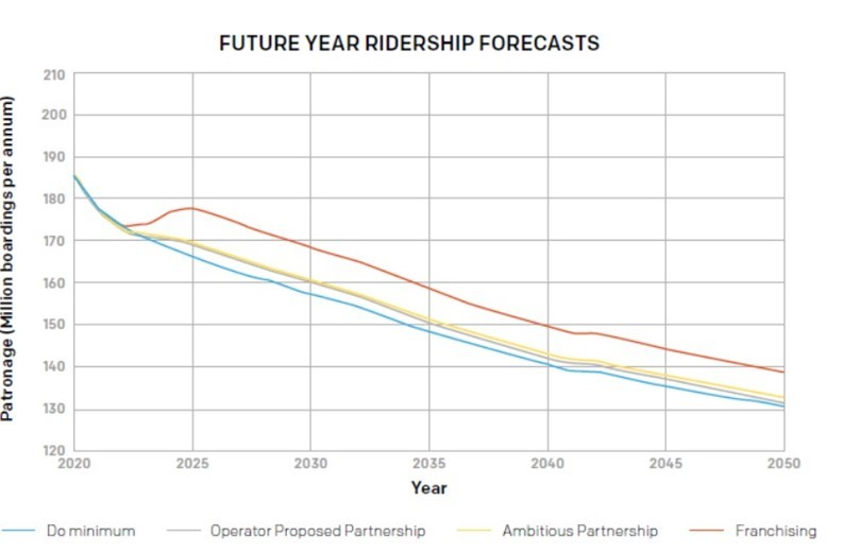
After being told countless times that franchising is the only way forward for buses, I was a bit taken back at the graph in Greater Manchester Combined Authority (GMCA) consultation which clearly demonstrates the significant patronage decline under a franchised regime that is anticipated. Yes, there will be the initial bounce or rather increase, like a new manager taking over a football team (with its associated costs), but the poor form soon returns. So is it really worth getting rid of the existing manager? Throwing money at a problem for an initial gain but no actual solution feels endemic of modern leadership, but when it comes to our public transport network or any fundamental national infrastructure, can we afford to let the ‘look what I achieved in a few years, now I am off to do something else’ approach fly?

 Figure A: GMCA Franchising Consultation Patronage Forecast

The glut of manager changes in the Premier League in November and December is timed to allow the new manager in charge to shop for new players who will hopefully bring a lasting change in performance to the January transfer window. GMCA’s equivalent, taken from their consultation ‘Doing Buses Differently’: “Further investment to improve the quality of the system is likely to be required to help stabilise the market. This further investment is collectively referred to as ‘Phase 2’ interventions and does not have committed funds at this time.”

This intended second phase of funds for the franchised network is telling! A very public emphasis on the affordability of franchising and how little tax payers will have to contribute to create a world class bus service has been prevalent. However, how likely is it that the second phase of interventions actually involves tax payers having to stump up extra cash? Also what is the strategy: what could these interventions be and what effect would they have? And why can’t they be planned for or undertaken now? There are three main options as far as I can see.


Fares reduction –

Reducing fares (or making the bus ‘more affordable’ as some see it) is a political winner, just like signing the on form striker – however like that striker it comes with a hefty price tag. Greater Manchester Mayor Andy Burnham has cited the benefit of £1.50 flat fare on London’s buses in the past. Research for TAS’s National Fares Survey 2019 shows the average single fare for a three mile journey in Greater Manchester to be £2.73, but we’ll say £2.70 to keep it simple. Dargay and Hanley (1999)[1] give a bus fare elasticity factor in metropolitan areas as -0.21 in the short term and -0.43 in the long term.

Put simply, for every 100 passengers at present, the fare reduction will attract nine more in the short term and a further ten (19 overall) in the long term. This means that whilst those 100 passengers at present generate £270 of revenue, in the short term the 109 will generate £164 and the 119 in the long term £179 giving an overall revenue reduction of 39.3% and 33.8% respectively.

Frequency increases on key routes –

If it isn’t cheaper, then it’s got to be better, a more frequent service tends to be the number one demand. This is slightly ironic given that GMCA have identified six of the heaviest used corridors in the Greater Manchester area as being ‘over bussed’. Balcombe et al (2004)[2] state that changes to bus service frequency have an elasticity of 0.38 in the short term and 0.66 in the long term.

If we take Stagecoach service 9 Wigan – Leigh – Higher Folds as an example. This currently runs every 12 minutes Monday to Saturday daytime with a Peak Vehicle Requirement of 10 Enviro 200 midi-buses. Increasing the frequency to every 10 minutes would thus increase patronage by 7.6% in the short term and 13.2% in the long term. However the cost would increase by 20% for the two extra vehicles alone, without taking into account the extra driver, fuel and maintenance costs.

Reduced Journey Time through Greater Priority –

Arguably one of the best ways to boost public transport use is to get motorists out of their cars and using it out of choice rather than necessity. Bus priority over cars through major junctions and more direct routes to reach traffic generators is key to this. This would also help environmental performance as fewer cars on the road will create less pollution. It is understandable that highway authorities might be more willing to invest in bus priority if the state sees a financial benefit from it, rather than this solely going to private operators. The operator would generally see a double benefit through increase in patronage and reduction or at least stabilising of resources needed to provide a service.

Balcombe et al (2004) quote a journey time elasticity of -0.4 to -0.6, say -0.5 as a halfway house. Service 163 takes up to 71 minutes from Heywood to Piccadilly Gardens in the morning peak and 52 minutes in the off peak. Reducing the peak journey time by 10 minutes would increase patronage by 1.07% whilst matching peak to off-peak running time would increase patronage by 1.13%. That might seems small however it is likely that the resource saving in the latter scenario would allow the peak frequency (currently every 12 minutes) to match the off peak frequency of every 10 minutes, which as shown earlier would see a further patronage increase of at least 7.6%.


Sharing the Risk and Reward

So if phase 1 of franchising isn’t going to reverse patronage decline in the long term but will still cost £134.5m by 2025, is there a better use for the money? Could you keep the same manager and spend the money saved on redundancy and attracting a new boss on new players? In this scenario commercial operators would then continue to use their decades of experience to provide a largely deregulated service, potentially under an Enhanced Partnership framework, or another model not yet considered in the debate. One that allows Transport for Greater Manchester (TfGM) to have a say on the quality and level of service provided. But how would you do that?

Low Fares –

As part of its ‘A better deal for bus users’ published September 2019, the Department for Transport (DfT) states that: “The government is actively looking to work with local authorities and operators to identify ways to encourage operators to implement multi-operator tickets and fares caps, either in relation to the price paid for individual journeys or a daily or weekly cap.” Given that GMCA’s plan for fares under franchising would see the multi-operator System One product reduced to the same price as the current cheapest operator only network product it would seem sensible for this to be undertaken as part of the DfT trial before a potentially irreversible alteration to the current system is made.

Increased Frequency and Reduced Journey Time –

These are best dealt with together as reducing the journey time can make increasing the frequency more viable, especially where there is a partnership approach between the operator(s) and local transport authority. However the commercially viable frequency may not be up to the level that GMCA or TfGM wish.

The key part of either an Advanced Quality Partnership or an Enhanced Partnership is that operators sign up to provide a certain quality of service in exchange for infrastructure improvements. However it still relies on the service being financially viable for the operator thus, as shown with service 163 earlier, a frequency of every 10 minutes all day might be the limit of what is a sustainable level of resource commitment.

However using a de minimis contract TfGM could pay the operator (currently Diamond Bus North West) to provide a frequency of every 8 minutes all day; the de minimis contract covering the cost of the extra resources required. The contract could be reviewed every year with a target patronage level growth set around 7.6% in the short term and 13.2% in the longer term. If the target is exceeded the de minimis payment would be reduced. This means the revenue and cost risks are shared.


Conclusion

As with any manager under fire it seems like the whole world is against them. In Greater Manchester the local media has come down on the side of the pro-franchising politicians and it seems that no one supports the existing set up. This is understandable considering even the government bastions of free enterprise seem to support franchising for political rather than ideological reasons. But can that change? Some football managers have seen a good run of results just at the right time to save them and crucially save their club some money which could be better spent on players.

The aim of my suggestions (a partnership between commercial operator and Local Transport Authority where the risk and reward of lower fares, higher frequencies and more bus priority are shared between parties) is to show that there is another way to attempt to reverse a critical aspect of the poor form without changing the manager. If implemented properly it could deliver service improvements that people want and save the council tax payers of Greater Manchester the cost of franchising Phase 2.

This of course only covers a small aspect of the franchising debate. In the end if GMCA and, crucially, the tax payers of Greater Manchester are willing to pay for it then franchising can be a success. However the aim of this article is to point out that there is a more affordable way to meet many of the goals of franchising bus services.


[1] The Demand for Public Transport: the effects of fares, quality of service, income and car ownership

[2] Bus fare elasticity, a report to the Department of the Environment, Transport and the Regions

© Copyright The TAS Partnership Limited 2016 The TAS Partnership Limited, Guildhall House, 59-61 Guildhall Street, Preston, Lancashire PR1 3NU | Tel: 01772 204988 A limited company registered in England and Wales Number 2929880, at the above address. Cookies on our websites: We use cookies to ensure we give you the best experience on our website.

☰ Menu

TAS is celebrating helping Galway-based Clare Bus successfully retender for services on its rural bus network.

Clare Bus is a not-for-profit local transport company that has provided public bus services for Clare and parts of South Galway in the Republic of Ireland since 2003. It operates low floor, easy access buses on twelve flexibly routed services under the National Transport Authority’s (NTA) Local Link programme.

All these services were put out to tender in November 2019, with the new arrangements to come into effect in the week commencing 13 January 2020. In view of the short period available for the completion of the bid documentation and the fact that retaining at least the majority of the operation was vital to the continuing viability of the company, Clare Bus approached TAS to provide support and advice on the content of their responses. TAS helped Clare Bus to provide:

• Methodology for transporting passengers including those with restricted or impaired mobility and evidence of how such an approach would be successful;
• Understanding of the challenges of operating in a rural environment and how these would be addressed; and
• Proposals for development and promotion of the services, with past supporting cases in point.

On 13 December, the NTA advised Clare Bus that they had been successful in retaining all their current operations thus ensuring that the company and their 25 employees can continue to deliver the community based and accessible services that have been enjoyed by their passengers (totalling more than 55,000 in 2018) in the past 16 years.

Clare Bus expressed their fulsome thanks to TAS for our help and guidance in securing this successful outcome.

Click here to view a link on the accessible nature of Clare Bus journeys.

For more information and if you would like similar support or support with any aspect of your transport networks, please contact Sarah Huntley on 01772 204988.

© Copyright The TAS Partnership Limited 2016 The TAS Partnership Limited, Guildhall House, 59-61 Guildhall Street, Preston, Lancashire PR1 3NU | Tel: 01772 204988 A limited company registered in England and Wales Number 2929880, at the above address. Cookies on our websites: We use cookies to ensure we give you the best experience on our website.

☰ Menu

The Bus & Coach Association (BCA)’s Judicial Review claim, calling for more stringent regulation of community transport (CT) operators with section 19 and 22 permits – and which could have led to the possibility of prosecutions for undertaking what BCA considers to be ‘commercial services’ – has been dismissed.

The High Court released their long-awaited judgement last week (6 December, 2019) following the BCA’s claim against the Secretary of State for Transport on 18 and 19 November, 2019.

The case hinges partly on an assumption by the Department for Transport (DfT) when implementing EU regulation on licensing, that operations under s19 and s22 permits were exempt from requiring an ‘O’ licence because they are deemed ‘exclusively for non-commercial purposes’.

The Court concluded that there was no dispute between the parties as to the applicable legislation or to the principles that should be adopted in interpreting it, hence no useful purpose would be served by issuing a declaration.

The outcome now paves the way for the DfT to clarify how it will regulate the issue and use of permits, and how it defines ‘non-commercial purposes’.

Commenting on the outcome, TAS director, John Taylor, who provided specialist advice on the Judicial Review, said: “The judgement has endorsed many of the specific points that we made and reached the conclusion that we anticipated. Now that it has been fought to a standstill in the courts, the time has come for a more constructive path to be pursued.

“The last five years have seen massive cuts to budgets for school, social care and public transport, and this has forced commissioning authorities to encourage a race to the bottom on a lowest cost basis. Now let’s turn this round and focus on the passengers.”

The Case Explained

BCA’s Call for Prosecutions

The claim, in effect against the DfT and DVSA, sought to apply pressure for more robust enforcement of EU regulation (1071/2009). The assumption was made by the DfT when implementing 1071/2009 into GB that operations under s19 and s22 Permits were exempt because their operations were “exclusively for non-commercial purposes”.

The BCA challenged this view, in the light of some Permit operators undertaking school and social care contracts, and indeed competitively tendering against PSV operators. In the BCA’s final claim, with language more in line with that of the DfT 2018 consultation on the CT permit system, it asked for a declaration on whether operations are exclusively for non-commercial purposes to take into account, in order of importance:
• The level of payment received;
• The proportion of work won in competitive procurement;
• The size and scale of operation in the market;
• Whether the operation could afford to licence as a PSV operator; and
• Whether the operator uses volunteers or relies on paid staff.

The BCA also asked for a declaration that where an undertaking does not operate exclusively for non-commercial purposes, then drivers cannot rely on the “non-commercial” exemptions from requiring a full D/D1 driving licence and a Driver CPC.

High Court Judgement in Summary

In its reasoning, the Court considered the appropriateness of making a declaration as to the law in a case where there was no particular set of facts to consider at the core of the dispute (nor were the associated operators represented), especially if the issue could impact on future criminal proceedings.

The BCA relied heavily on a European Court judgement in a case (Lundberg) involving a rally driver stopped from driving a lorry, carrying his rally car, without a tachograph; he was deemed exempt from tachograph rules because he was not being paid to drive. The High Court concluded firmly that this case is not relevant to 1071/2009, as it concerned a differently worded regulation with different subject matter and had no application to the situation with which this case was concerned.

The Court also concluded that in the absence of a specific dispute about interpretation of the phrase “exclusively for non-commercial purposes”, it could not and should not make an abstract declaration, and that, even if it did that, declaration would have no binding legal force. It recognised that there will be disputes about whether a particular operator comes within the exemption or not, but that will depend upon the facts in any particular case, and it acknowledged that determining this may be far from straightforward. However the Court was not asked to adjudicate on a specific case.

A further conclusion was that if the applicable legislation is clear, then there is no justification for the DfT (and DVSA) to delay taking any enforcement decisions on the grounds that “the law isn’t clear”. Applying the rules may be difficult but that is not a good reason to avoid enforcement.

Comment from TAS Partnership Director, John Taylor

At the heart of this case, lies a fundamental difficulty in coming up with abstract interpretations of the meaning of “non-commercial purposes” – the moment a simple principle is reached, a countervailing case is likely to arise that renders it unfit for purpose.

The community transport sector will be relieved that the BCA has been unsuccessful in persuading the Court to make a declaration as to the law. If the BCA’s original formulation had been accepted there is no doubt that a major crisis would have occurred and service continuation would have been put in doubt.

The BCA may, however, console itself that the Court has accepted one of its contentions which was that the DfT and DVSA were unjustified in delaying making enforcement decisions. In essence the Court has put the ball back firmly in the DfT’s court and told it to face up to the fact that the legislation, as currently worded, is difficult.

However, the judgement gives little of the clarity for which both the community and commercial transport sectors might have been hoping. Consequently, the DfT must now produce much more detailed, explicit and nuanced guidance than it has managed to date. In its proposals so far, it has focused on interpreting “non-commercial”. The Court has explicitly rejected this approach. In its next attempt to draft guidance, the DfT will have to grapple with understanding the community transport sector’s varied purposes and identifying the factors associated with these.

Further Information

• The Judicial Review claim by the BCA follows consultation by the DfT in 2018 “Consultation on the use of section 19 and section 22 permits for road passenger transport in Great Britain”
• To read the full ruling by High Court, visit: www.bailii.org
• For more information about any aspect of the Judicial Review case and its background, please contact John Taylor on 01772 204988 or by emailing him directly.

To see more about this click here for the TAS commentary which is focused upon implications, and here for the Russell-Cooke LLP commentary which is focused on interpretation.

© Copyright The TAS Partnership Limited 2016 The TAS Partnership Limited, Guildhall House, 59-61 Guildhall Street, Preston, Lancashire PR1 3NU | Tel: 01772 204988 A limited company registered in England and Wales Number 2929880, at the above address. Cookies on our websites: We use cookies to ensure we give you the best experience on our website.

☰ Menu

Principal Consultant John Atkins considers the effectiveness of DFT’s Total Transport project. To read the article click here to view the pdf in a new tab.

© Copyright The TAS Partnership Limited 2016 The TAS Partnership Limited, Guildhall House, 59-61 Guildhall Street, Preston, Lancashire PR1 3NU | Tel: 01772 204988 A limited company registered in England and Wales Number 2929880, at the above address. Cookies on our websites: We use cookies to ensure we give you the best experience on our website.

☰ Menu

TAS Partnership director, John Taylor, has urged community transport operators against pursuing the Short Distance Exemption from ‘O’ licensing (introduced from 1 October 2019) – warning them that to do so before the forthcoming Judicial Review concludes would be to fall into a trap.
Speaking at the CTA UK’s CT’19 event in Manchester on Wednesday (13 November), John said: “The simple message is: don’t go there!”

The ‘short distance’ exemption would over-ride the current arguments about whether section 19 and 22 permits are being used for ‘non-commercial purposes’ but would only cover:
• services operating within a radius of ten miles from pre-determined central points; and/or
• services where the first point at which passengers can get on is no more than ten miles measured in a straight line from the last point at which they can get off

The regulations would allow some occasional services to go beyond that limit, and operators can apply to extend the 10 mile threshold in extenuating circumstances, primarily in rural areas. As John pointed out – “what constitutes a short distance differs enormously between central London and the Isle of Skye”.

The new regulations require permit operators to ensure that they are an “exempt body” under EU Regulation 1071/2009. There are three routes to exemption:
• that transport is not the main occupation of the operator; OR
• that they are operating exclusively for non-commercial purposes; OR
• that their operations all fall within the ‘short distance’ criteria.

However, John advised operators against opting for the ‘short distance’ exemption: “Operators should not abandon the idea that they are operating for non-commercial purposes. My guidance is that if any changes are required, operators should identify how they can continue to meet the non-commercial purposes exemption.”

This advice comes in advance of the Judicial Review claim brought by the BCA against the Secretary of State for Transport, due in the High Court on 19/20 November. The claim seeks to mandate DVSA to escalate enforcement action to prosecution CT operators running services under contestable contracts, because such contract work should not be considered ‘non-commercial’. Regardless of the outcome, the Department for Transport has promised a review of the Permit system next year, including the role of ‘designated bodies’ that can issue permits.

The TAS Partnership has been assisting CT operators to make strategic changes to their business models to reduce the current uncertainty they face. TAS has now developed a package of support and guidance for community transport operators faced with these very difficult challenges.

For more information or guidance about any of these issues, please contact John Taylor on 01772 204988 or email John Taylor

© Copyright The TAS Partnership Limited 2016 The TAS Partnership Limited, Guildhall House, 59-61 Guildhall Street, Preston, Lancashire PR1 3NU | Tel: 01772 204988 A limited company registered in England and Wales Number 2929880, at the above address. Cookies on our websites: We use cookies to ensure we give you the best experience on our website.